December brings in a big share of a nonprofit's online revenue, yet most teams plan it with last month's reports. The giving season is won in September, October and November, by moving from calendar to behavior, from acquisition to retention, and from reporting to prediction.
First published on LinkedIn on 26 August 2025. Edited for this site on 6 November 2026: every number links its source.
Every December, nonprofit leaders shift into survival mode.
The December Reckoning: Why 40% of Your Online Revenue Depends on What You Do in the 90 Days Before December
Bottom Line Up Front:December is the most important month of the year for online revenue, but most nonprofits are managing this tsunami with spreadsheets and prayer. The organizations that survive, and thrive in a donor retention crisis, aren't the ones working harder. They're the ones working smarter.
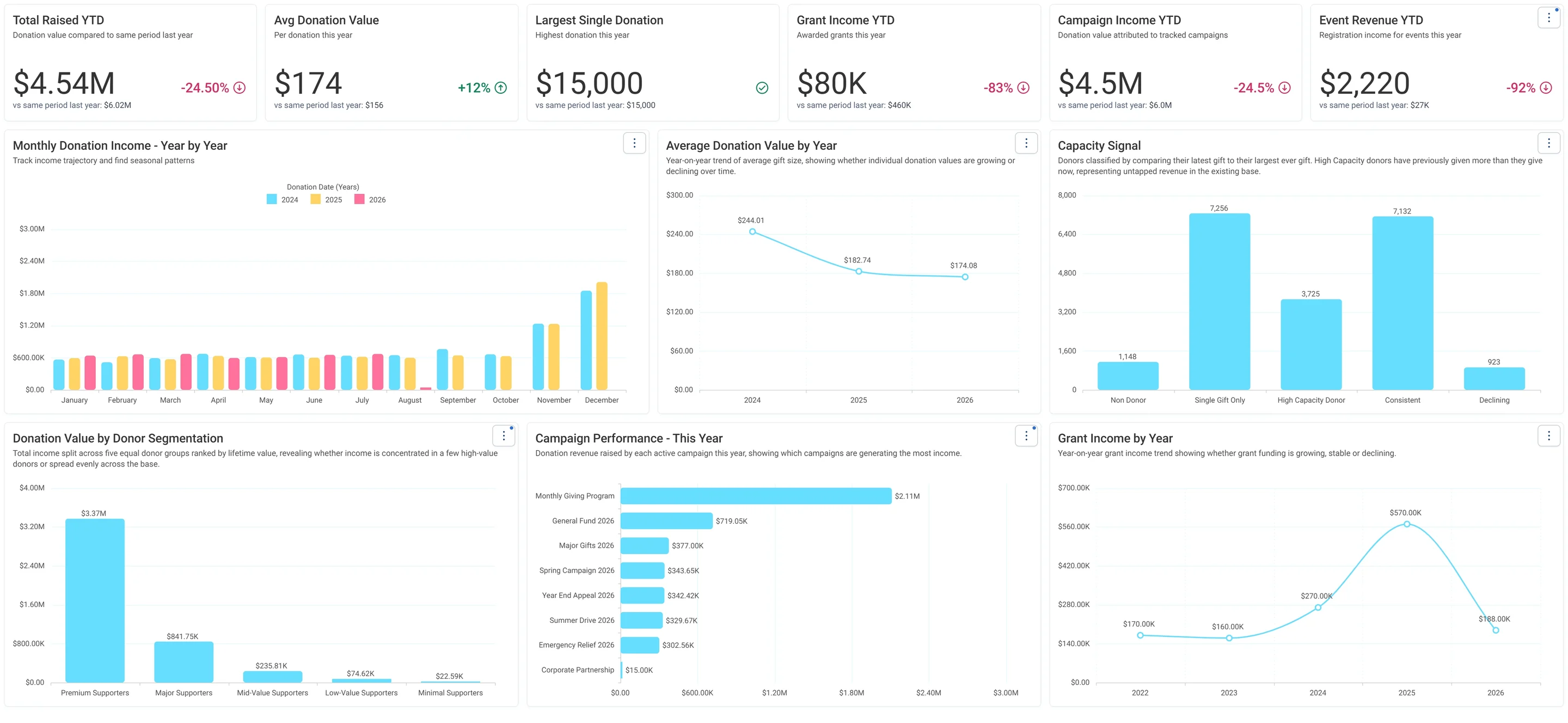
Charity Overview · Fundraising This chart shows donation income for each month, year by year. The tall bars at the end of the year show how much of the giving lands in December.Year-end LYBUNT list: who hasn't given? | Year-End Recovery
Every September, we watch the same pattern unfold across the nonprofits we work with: Development, communications, and fundraising teams staring at calendars, realizing they have 90 days to execute campaigns that will determine whether they hit their annual goals or explain to their boards why they came up short.
This isn't a problem. It's a crisis masquerading as predictability.
Here's why this concentration is killing nonprofits:
Operational Burnout: Your team runs far past normal capacity while trying to adjust campaigns in real time
Technology Failures: Systems built for steady-state operations crash under December surge loads
Strategic Blindness: You're so busy executing that you can't see what's working until it's too late to change course
And starting your year-end campaign in December is like training for a marathon by showing up on race day.
The Data That Should Terrify You (And What to Do About It)
The Donor Retention Apocalypse:
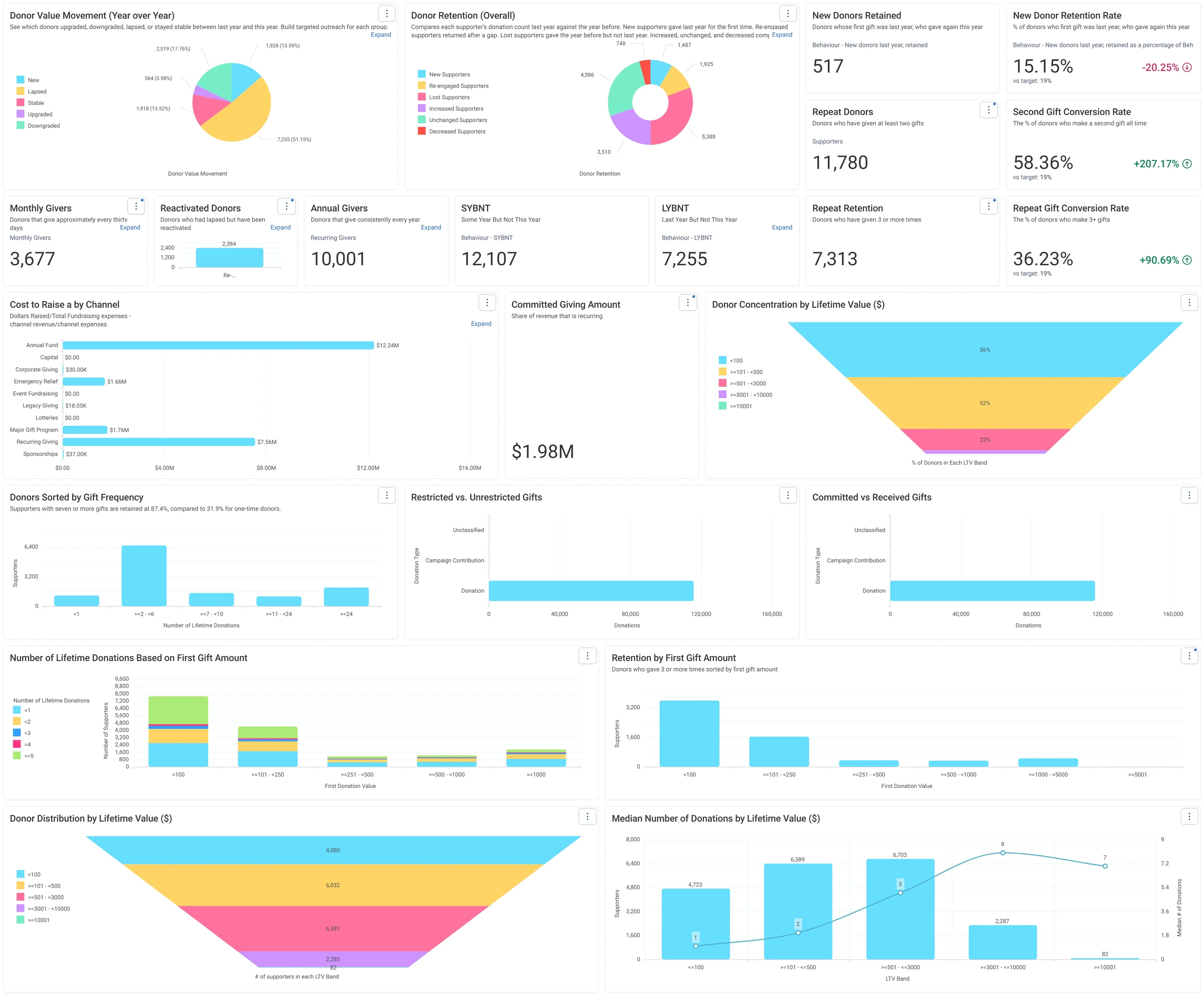
Jumping Off Metrics · Donor Health - Board Report This is the Donor Retention chart. It shows how many supporters are new, came back, stayed or were lost since last year.
Every December, nonprofits celebrate record-breaking acquisition numbers while ignoring how few of those new donors will ever give again.
Truth #3: You're Managing December with Rearview Mirror Data
Monthly reports tell you what already happened. December success requires knowing which donors are likely to give, when they'll give, and how much, before you send the first email.
Without well-integrated fundraising technology, you're making December campaign decisions based on outdated, incomplete data. While you're pulling last month's reports, your donors' giving patterns are shifting in real-time based on economic conditions, personal circumstances, and engagement with your content.
The Real Cost of Status Quo Thinking
Let's dig deeper into what mediocre insights actually costs nonprofits beyond just missed dollars.
The Fundraising Effectiveness Project's Q4 2024 data puts first-time donor retention at just 19.4%. But here's what the data doesn't show: the long-term damage of poor donor experiences during their most generous moments.
Consider this scenario: A $5M nonprofit acquires 1,000 new donors in December at $75 each. With average retention, 190 donors return the following year. With better retention, 280 donors return - that's an additional $6,750 in Year 2 revenue from one December campaign.
But multiply this across the donor lifetime:
Year 2: $6,750 additional revenue
Year 3: $5,063 additional revenue (75% retention of the extra donors)
Year 4: $3,797 additional revenue
Year 5: $2,848 additional revenue
5-year impact: about $18,500 from one improved December campaign
Now extrapolate this across a dozen December campaigns and you're looking at about $220,000 in lost lifetime value from weak December performance alone, before you add gift size increases from better segmentation or referral impacts from satisfied donors.
Case Study: What Data Infrastructure Transformation Actually Looks Like
Consider a hypothetical $5M health nonprofit, let's call them "Regional Health Foundation" that represents the journey many organizations are taking from manual processes to strategic automation.
The Starting Point:
Decentralized data across 5+ systems
Monthly reports taking 2-3 weeks to generate
December campaign preparation starting in October with manual donor segmentation
Staff working 60+ hour weeks during peak giving season
Campaign decisions based on "what worked last year" rather than real-time data
The Strategic Questions This Enables: With real-time data infrastructure, Regional Health Foundation could finally answer questions that manual processes made impossible:
Which donors respond to urgency versus inspiration messaging?
What optimal timing maximizes gift size by demographic?
How do weather patterns affect regional giving behavior?
The Questions That Separate Winners from Survivors
Before you plan another December campaign, answer these:
Operational Intelligence:
Can you predict which donors are likely to give and at what amount before sending appeals?
Do you know the lifetime value difference between donors acquired in December vs. other months?
Can you identify which first-time donors are most likely to become long-term supporters?
Strategic Clarity:
Are you building for December revenue or lifetime donor value?
How do you score donors for personalized ask amounts rather than one-size-fits-all appeals?
The Playbook: Three Strategic Shifts That Actually Work
Shift 1: From Calendar-Based to Behavior-Based Campaigns
Stop sending the same message to everyone on the same day.
Implementation: Segment by engagement history, giving frequency, and response patterns. Your monthly donor should get different messaging than your annual giver who always responds to urgency appeals.
Shift 2: From Acquisition-Obsessed to Retention-Focused
You're paying to acquire new donors, then losing about 80% of them after their first gift. December campaigns that prioritize volume over retention are building tomorrow's problems.
Implementation: Design December campaigns around donor lifetime value, not just immediate revenue. This means different messaging sequences for first-time vs. returning donors, and stewardship plans that start the moment someone gives their first gift.
Shift 3: From Reactive Reporting to Predictive Intelligence
Monthly reports tell you what already happened. December success requires knowing which donors are likely to give, when they'll give, and how much, before you send the first email.
Implementation: Use behavioral data to score donor likelihood and optimal ask amounts. Instead of sending the same appeal to everyone, send personalized asks based on giving probability and capacity indicators.
The 90-Day Window: Your Action Plan
Days 1-30 (September):
Audit your current data infrastructure
Identify your highest-value donor segments
Test every donation page on mobile
Days 31-60 (October):
Build predictive donor scoring models
Create retention-focused email sequences for different donor segments
Implement behavioral tracking and preference indicators
Days 61-90 (November):
Deploy and test personalized ask amounts based on donor scoring
Adjust retention messaging based on early performance data
Prepare stewardship sequences that activate immediately after first gifts
The Reality Check
Here's what we've learned after years of working with nonprofits: The organizations that thrive during December aren't the ones with the most resources. They're the ones that refuse to accept "that's how we've always done it" as a strategic framework.
Your December results are determined in September and October, by the infrastructure decisions you make then.
The question isn't whether you can afford to invest in better systems, real-time data, and sharper strategy. The question is whether you can afford not to, when 40% of your online revenue depends on executing flawlessly during the most chaotic 31 days of the year.
Because while you're debating whether to upgrade your approach, winning organizations are already building the predictive capabilities and retention-focused systems that will pay off when December arrives.
The December reckoning is coming. The only question is whether you'll be ready for it.