The Hidden Cost of Gala Attribution: Why Nonprofits Are Missing Millions in ROI
Article by Kyle Keith, 2 September 2025
Most nonprofits judge a gala by what it raises on the night. Kyle argues for tracking how events change donor behavior over the following months and years, and sets out a simple framework for measuring that long-term impact.
First published on LinkedIn on 2 September 2025. Edited for this site on 6 November 2026: every number links its source.
The Hidden Cost of Gala Attribution: How Nonprofits Can Prove Their Biggest Events Drive Million-Dollar Impact
I saw a post from Julie Masson that had me consider the lens through which NFPs view their marquee fundraising events. I want to add some research and my thoughts on how organizations can measure the impact of their biggest events. Thanks for sharing Julie.
In my experience, most nonprofits are making million-dollar gala decisions based on a fraction of the data they actually need.
The Attribution Blind Spot Costing Charities Millions
The OneCause 2024 Fundraising Outlook Report, based on a survey of 939 fundraising professionals, found that against their 2023 event fundraising goals, 75% of organizations were in line with or raised more than their budget. Yet in my experience, the vast majority cannot measure the long-term impact of those events. In my view, this blind spot costs nonprofits millions in unrealized potential, because they can't make a compelling case for high-ROI activities without a complete picture of the impact of individual events.
In my experience, organizations also struggle to separate donor interest in events from support for the mission, which makes it impossible to tell whether attendees take part because of their commitment to the organization or for social reasons.
The Multi-Touch Attribution Complexity
In my view, multi-touch attribution is the most significant measurement challenge nonprofits face. Events typically serve as cultivation touchpoints in complex donor journeys rather than direct conversion opportunities, but current measurement approaches rely on simplistic "last-touch" attribution models. This particularly undervalues events, which often provide essential relationship-building that enables major gifts months or years later.
Hidden costs create additional distortions. Graham-Pelton notes that events cost an organization 50 cents for every dollar raised, and that they come with hidden costs, such as staff time, that should also be considered. In my experience, organizations typically calculate only direct expenses like venue rental and catering while ignoring the substantial staff time they invest.
Keeping first-time donors is hard everywhere. The Fundraising Effectiveness Project's 2024 report found that only one in five donors who were new in 2023 gave again in 2024, a new donor retention rate of 19.4%. And in my experience, most organizations lack the systems to distinguish between event-acquired donors and those acquired through other channels.
The Questions Every Event Should Answer
When somebody attends a gala, are they more likely to:
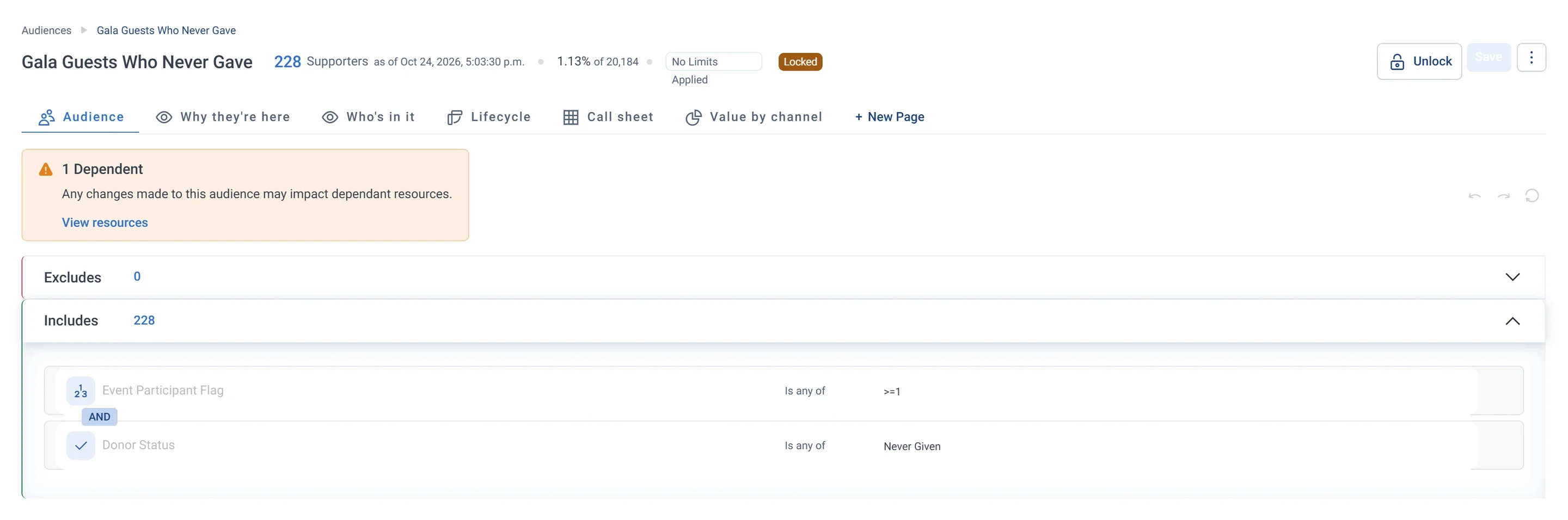
Gala Guests Who Never Gave · Audience rules This is the audience of gala guests who never gave. Its rules say they came to an event and have never made a gift.How to turn event guests into donors | From Guest to Giver
Give at year end?
Become monthly donors?
Leave end-of-life gifts?
Increase their annual giving amount?
Bring friends who become new donors?
Volunteer for the organization?
Without systematic tracking of these behaviors, organizations operate with massive blind spots that prevent them from understanding true event ROI and making data-driven decisions about resource allocation.
What Advanced Attribution Looks Like in Practice
Data Platform architecture fundamentally transforms nonprofit attribution challenges by creating unified data foundations that capture and analyze donor interactions across all touchpoints. Unlike traditional nonprofit CRMs that focus on transactional records, Data Platforms bring together behavioral data from websites, email engagement, and event interactions to build comprehensive donor profiles.
The technical architecture enables multi-touch attribution modeling that tracks donor journeys from initial event invitation through long-term behavioral changes. Key capabilities include:
Data integration that brings every touchpoint into one view
Behavioral modeling engines that identify patterns in donor engagement post-event
Predictive analytics that forecast future giving based on event participation history.
Event-specific tracking capabilities monitor pre-event registration sources and invitation responses, during-event session attendance and networking interactions, post-event follow-up responses and survey completion, and long-term donation behavior changes and engagement shifts.
Behavioral Analytics for Event Attribution
Advanced behavioral analytics enable precise long-term attribution measurement through methodologies for isolating event impact from other donor engagement factors. Multi-touch attribution frameworks must account for pre-event touchpoints (invitations, marketing), during-event interactions (attendance, engagement, networking), post-event follow-ups (communications, impact reports), and long-term behavioral changes (giving frequency increases, engagement pattern shifts).
Cohort analysis provides essential methodology for tracking long-term behavior patterns. Organizations can group donors by event attendance timing, then measure retention and behavior changes at set intervals after the event, for example at 30, 60, 90, 180, and 365 days. Behavioral cohorts segmented by engagement level during events (high, medium, low interaction) reveal differential impact patterns that inform future event planning.
Time-series analysis enables measurement of event impact across multiple windows, for example: immediate (0-30 days), short-term (31-90 days), medium-term (91-365 days), and long-term (12+ months). This framework accounts for relationship building phases and sustained behavioral change patterns that traditional attribution approaches miss entirely.
Building Your Attribution Framework
Delayed outcome measurement can apply, for example, this simplistic weighting model: 100% attribution to events for 0-30 day outcomes, 75% for 31-90 days (relationship building phase), 50% for 91-180 days (sustained engagement), 25% for 181-365 days (long-term influence), and 10% for 12+ months (foundational impact). This simplified framework provides a baseline that should be refined through organization-specific testing and behavioral modeling.
Enhanced ROI calculation must extend beyond traditional event metrics to include time-weighted revenue attribution across multiple measurement windows. Comprehensive formulas incorporate, for example, direct donations during/after events, increased monthly giving over 12-month periods, major gift upgrades within 18 months, planned giving commitments, volunteer value contributions, and peer-to-peer fundraising generated through event networks.
Cost allocation frameworks must include comprehensive investment calculations: direct costs (venue, catering, materials), staff time (planning, execution, follow-up), marketing and promotion expenses, technology platform costs, and opportunity costs of alternative fundraising activities. This complete cost picture enables accurate ROI assessment and strategic resource allocation decisions.
Implementation Through Expert Partners
Organizations implementing advanced event attribution systems should follow phased approaches beginning with foundation building, advancing to predictive modeling deployment, and culminating in continuous improvement. Specialized nonprofit data consultancies provide implementation services that can be activated for events. Apteco partners such as Euler, whose services include data platforms, analytics, segmentation and machine learning models, and Adroit Data & Insight, who delivered the International Fundraising Leadership Forum's global benchmarking project, offer support that reduces the need for internal technical resources.
Key performance indicators must span, for example, immediate metrics (0-30 days) including attendance rates and direct conversion, medium-term metrics (31-365 days) focusing on retention and giving pattern changes, and long-term metrics (12+ months) measuring lifetime value increases and planned giving commitments. Predictive models should be held to a clear concordance target, with continuous monitoring of precision, recall, and statistical significance.
The Strategic Advantage
Adroit's benchmarking work for the International Fundraising Leadership Forum (IFL) holds non-personal data for 76 million donors and 400 million+ gift records, from organizations with a combined annual individual giving income of more than $3.1 billion. It shows that advanced donor analysis can work at that scale and change how nonprofits understand their biggest fundraising investments.
The transformation from intuition-based event planning to data-driven strategies that demonstrably enhance long-term donor relationships represents a fundamental competitive advantage. The nonprofits implementing comprehensive attribution systems now operate with strategic insights their competitors cannot match - they can prove which events drive million-dollar long-term impact and plan accordingly.
Are you tracking how your marquee events influence donor behavior 12-18 months later, or are you missing the million-dollar attribution story?