Building the Complete Donor Optimization Engine: From First Touch -> Major Gift Giver (AI, Insights, & Modeling)
Article by Kyle Keith, 11 September 2025
Much of the AI sold to fundraisers is predictive modeling made easier to use. Kyle Keith sets out how behavioral signals already in your donor database, from gift progression to engagement and response timing, can find future major donors, and how to build that systematically.
First published on LinkedIn on 11 September 2025. Edited for this site on 6 November 2026: every number links its source.
Many charity leaders think they need "AI" to move donors up their giving ladder. In my view, a lot of AI hype is years-old technology packaged in new marketing, and it misses the behavioral signals that predict your next major donors.
Every day, potential major donors interact with your charity through micro-behaviors that signal their escalating commitment. Yet most organizations treat donor development like a lottery rather than a systematic, predictable process.
Why Your Current Donor Journey Mapping Misses Future Major Donors
Here's what's actually happening in your donor pipeline right now:
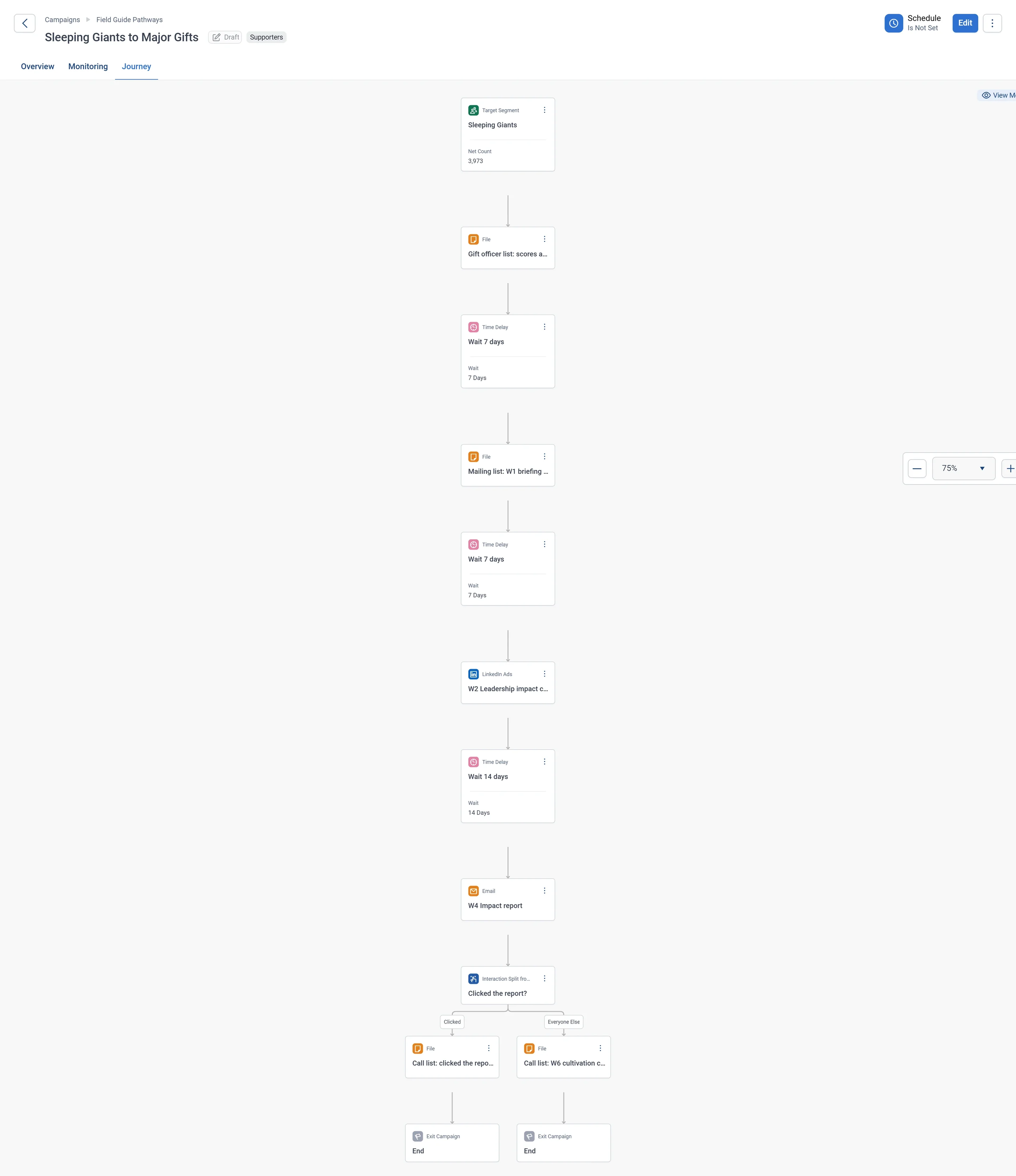
Sleeping Giants to Major Gifts · journey, part 1 of 2 This is the Sleeping Giants to Major Gifts journey. Each step follows from what the donor did, from the first touch toward a gift officer call.Find major donor prospects | Sleeping Giants to Major Gifts
Your future major donors are exhibiting predictable patterns today. These prospects show specific early signals: consistent small gifts that increase over time, high email engagement rates, quick response to communications, and engagement with content beyond donation requests.
In my view, the "AI" platforms you're evaluating use the same predictive modeling techniques that data scientists have used for years. What changed wasn't the algorithms. AutoML emerged in 2014, and in 2016 Microsoft declared its aim "to take it from the ivory towers and make it accessible for all", but practical applications remained confined to technical experts until recent platforms democratized these capabilities through visual interfaces.
Today's "AI revolution" in fundraising is, at heart, sophisticated predictive modeling now accessible through user-friendly platforms. The breakthrough is democratization, not innovation.
The Behavioral Modeling Methodology That Identifies Tomorrow's Major Donors
Forget the technology buzzwords. Here's the systematic approach that transforms first-time donors into major gift prospects:
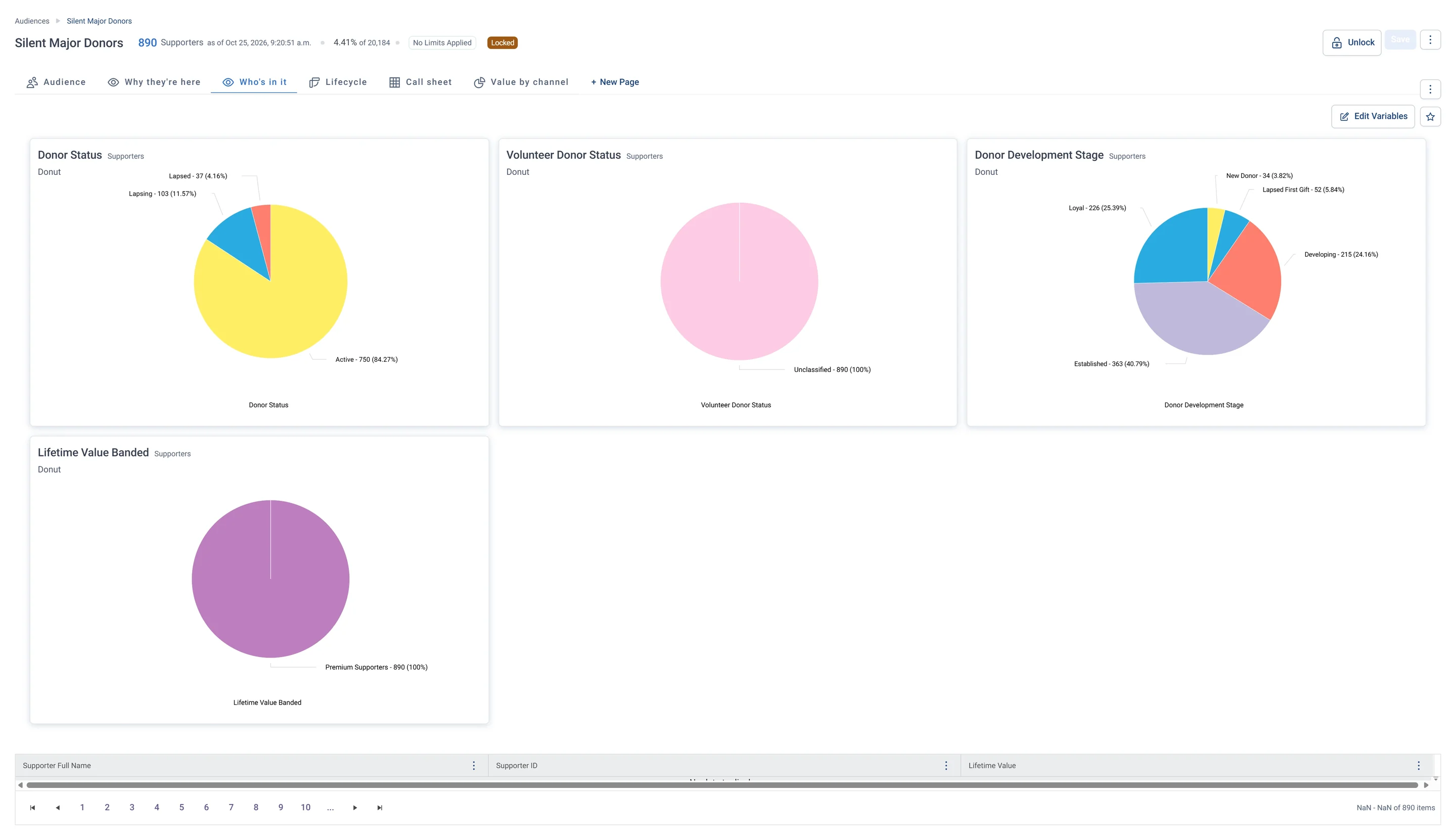
Silent Major Donors · Who's in it This is the Who's in it page for the Silent Major Donors audience. It shows their donor status, their stage and their lifetime value in one look.
Single Donor View Architecture consolidates every touchpoint: transactions, communications, events, website behavior, volunteer activity, into unified behavioral profiles. This reveals cross-channel patterns invisible in siloed CRM systems.
Early Signal Detection Models identify major donor potential before traditional indicators appear. The methodology analyzes gift amount progression, frequency changes, seasonal giving patterns, communication engagement evolution, and response timing to different message types.
Predictive Lapse Prevention enables proactive retention of high-value prospects before they lapse.
Dynamic Journey Orchestration constructs personalized major donor cultivation sequences based on individual behavioral triggers rather than mass campaign schedules.
Real-Time Scoring Systems update major donor potential continuously based on micro-behaviors, enabling immediate cultivation response to engagement changes rather than waiting for annual prospect reviews.
The Quantified Results: Moving Donors From First Gift to Major Gifts
The numbers show what systematic major donor development can do:
NextAfter's benchmarks of digital-first organizations found broad base online revenue grew 99% over five years, compared to 36% for offline. These organizations also saw an 18.6% increase in major gifts and a 32.4% increase in mid-level giving over the same five years.
Advanced Behavioral Analytics: The Technical Foundation for Major Donor Development
Time-Series Analysis: AI-assisted forecasting models can learn seasonal patterns, and some can handle the missing data that characterizes real-world donor behavior.
Multi-Touchpoint Attribution Modeling reveals complete donor journeys from first contact to major gift commitment. Machine learning-powered attribution can share credit across touchpoints automatically, giving a truer picture than single-touch attribution of which campaigns develop major donors.
Behavioral Clustering Techniques support major gift prospect identification. Feature engineering that combines donation patterns, engagement behaviors, and demographic data enables precise donor classification for targeted major donor cultivation.
Real-Time Processing Architecture using purpose-built data architectures handles both batch processing for historical analysis and real-time streaming for immediate behavioral response, enabling immediate cultivation responses to behavioral triggers.
Essential Data Architecture for Your Major Donor Pipeline
Comprehensive Data Requirements form the foundation of effective major donor behavioral modeling. Leading systems integrate donor profile data (demographics, giving history, engagement metrics), real-time behavioral tracking (email interactions, event participation, website engagement), and external enrichment data (wealth indicators, social media activity, third-party demographic overlays).
Statistical Validation Methodologies ensure model reliability for major donor identification.
Integration Framework Requirements for multi-source data platforms demand careful attention to data quality, privacy compliance, and real-time processing capabilities. Essential integrations include CRM systems, payment processors, email platforms, event management, social media monitoring, and wealth screening services to create comprehensive behavioral profiles.
The Strategic Implementation Framework: From Reactive Campaigns to Systematic Major Donor Development
Organizations seeking major donor pipeline transformation face a methodology choice: continue demographic-based prospect identification or implement systematic behavioral modeling approaches.
The most successful implementations follow a structured progression:
Phase 1: Data Quality Foundation Assessment - Can your systems support unified donor behavior tracking across all touchpoints? You need enough transaction history, combined with comprehensive engagement data, to identify reliable major donor prediction patterns.
Phase 2: Behavioral Variable Identification - Which micro-behaviors in your donor base correlate with major gift potential? Email engagement evolution, multi-gift campaign participation, and cross-channel behavioral migration can indicate changing donor relationships months before traditional indicators appear.
Phase 3: Predictive Model Development - Starting with models for lapse prediction, implementing real-time scoring systems, and gradually building toward comprehensive behavioral analysis supporting major donor identification and cultivation.
Risk Mitigation and Success Factors
In my view, the total cost of ownership reveals the hidden economics: while platforms appear accessible upfront, organizations implementing comprehensive behavioral modeling without proper methodology spend significantly more on customizations, performance tuning, and workaround development compared to systematic approaches.
Implementation success requires human-AI partnership where technology enhances rather than replaces relationship-building capabilities central to major donor development. The most critical success factor involves systematic methodology adoption combined with organizational commitment to data-driven major donor cultivation rather than intuition-based approaches.
A culture of continuous improvement sustains competitive advantage. Organizations must address model drift through regular retraining schedules, ensure privacy compliance, and establish gradual rollout procedures for new algorithms while maintaining the personal relationships that define successful major donor development. This can be done through implementation partners, training courses, and updated templated models.
The Competitive Reality: Systematic vs. Reactive Major Donor Development
I believe systematic behavioral modeling methodology transforms major donor identification and cultivation effectiveness.
What separates successful major donor development programs from average performers isn't technology sophistication, it's methodological commitment to understanding that donor behavior contains predictive signals that reveal major gift potential years in advance.
The platform exists. The methodology is proven. The models have been built. The results are quantified across multiple charity sectors.
Organizations that embrace behavioral modeling methodology for major donor development gain sustainable competitive advantages in cultivation effectiveness and donor lifetime value. Those that continue treating major donor identification as demographic guesswork rather than systematic behavioral analysis will continue achieving industry-average results while competitors transform their fundraising effectiveness.
Your donor database contains years of behavioral signals that predict major giving potential. The question isn't whether behavioral modeling works for major donor development: it's whether your organization will implement the systematic methodology required to move donors from first contact to transformational gifts.
The choice facing charity leaders is clear: continue reactive, campaign-driven approaches that treat major donor development as unpredictable, or implement systematic behavioral modeling that transforms first-time donors into predictable major gift prospects through evidence-based cultivation strategies.
While this behavioral modeling methodology may sound technically complex, the foundational work has already been completed. Companies like Apteco have developed ready-to-deploy solutions specifically designed for charity donor development, with pre-built templates for major donor identification, lapse prediction, and lifecycle progression modeling. These systems can be implemented through certified implementation partners who specialize in charity applications, comprehensive training programs that require no technical background, and industry-specific model templates that have been refined across many charity implementations. The methodology is proven, the technology is accessible, and the implementation pathway is well established. Organizations don't need to build these implementations from scratch.
The RNLI's Supporter Journey Transformation: £285,756 Additional Donations
The Royal National Lifeboat Institution faced the classic charity challenge: its teams marketed to supporters independently, so the best supporters were marketed to by every team while others were ring-fenced against certain products.
The breakthrough came when the RNLI used insight from Apteco FastStats to create a new single supporter view (SSV) and a clusters segmentation built on supporter behavior: online interaction, email opens, volunteering, event attendance, and each supporter's tenure and history. Rather than focusing on demographic capacity indicators, they identified supporters whose behavior showed deepening commitment.
The transformation wasn't about technology, it was about understanding that supporter potential reveals itself through supporter journey analysis and behavioral segmentation.
Barbudo, Ventura and Romero, 'Eight years of AutoML: categorisation, review and trends', Knowledge and Information Systems (Springer), 2023: AutoML emerged in 2014