The Salesforce Marketing Cloud Data Retention Crisis Nobody's Talking About
Article by Kyle Keith, 19 September 2025
Salesforce Marketing Cloud keeps its most detailed tracking data for months, not years, while donor behavior plays out over many years. Kyle Keith explains why that gap weakens donor prediction and what to ask about your own data history.
First published on LinkedIn on 19 September 2025. Edited for this site on 6 November 2026: every number links its source.
"Our donor predictions are based on just six months of data?"
This realization is hitting fundraising organizations across the sector as they discover their platform's data retention limitations. Teams are trying to predict lifetime giving patterns while missing entire seasonal cycles and annual giving trends.
For fundraising organizations, this creates a strategic crisis. Supporter giving patterns span multiple annual cycles, not just six months. Understanding who upgraded from $25 to $250 donations requires analyzing behavior across numerous campaign cycles, multiple year-end seasons and several economic conditions, far beyond the six-month window available in detailed tracking data.
The Predictive Analytics Mirage
You cannot predict future behavior from six months of data.
Effective donor modeling needs multiple annual cycles of history at a minimum. It requires:
Multiple complete annual giving cycles to identify true lifecycle stages
Several year-end seasons to understand seasonal giving trends
Numerous campaign responses across channels to improve future targeting
Extended frequency progression analysis spanning multiple years
Long-term lapse and reactivation patterns requiring dozens of campaign cycles
With detailed data covering just six months, you're missing the complete donor story. Every long-term prediction becomes compromised by incomplete campaign cycle history.
In my view, the policy is confusing: different data types have different retention periods, making it nearly impossible for organizations to understand what historical analysis is actually possible without extensive technical knowledge.
Many organizations spend months refining their analytics approaches, not realizing that the fundamental limitation isn't their methodology. It's the data retention architecture itself.
The Business Impact
Data-driven fundraising requires historical context. With limited data retention, organizations miss:
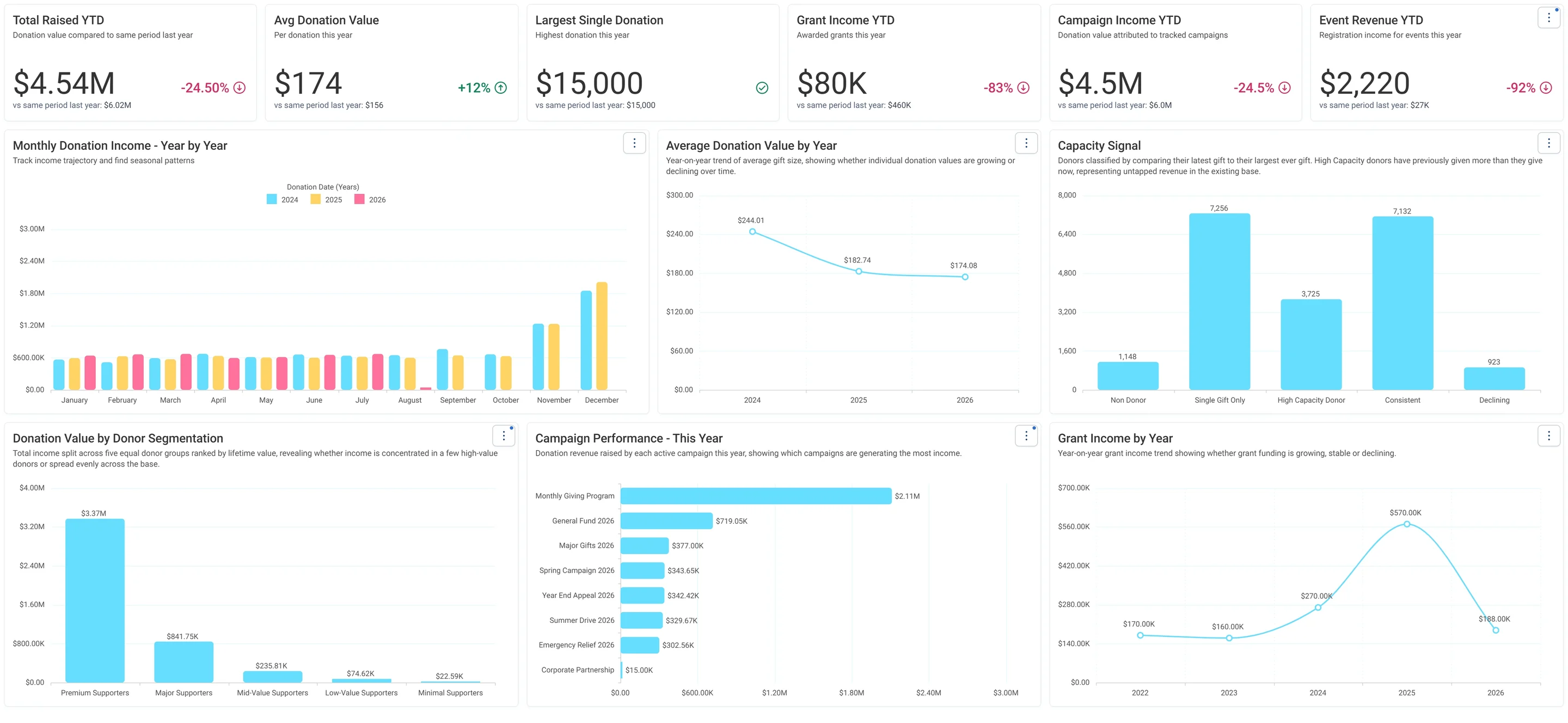
Charity Overview · Fundraising This chart shows donation income by month across several years. Seeing the same months side by side needs history, which is what a short window cannot give.
Donors showing gradual engagement increases over years
Seasonal giving patterns that predict major contributions
Multi-channel attribution across long supporter journeys
Early warning signs of donor disengagement trends
Long-serving donors who have stayed active for many years
The Questions to Ask
This insight becomes a useful diagnostic tool. Ask any organization using Salesforce Marketing Cloud:
"When was the last time you analyzed supporter engagement patterns spanning more than 2 years?"
"If you wanted to identify donors who increased giving gradually over the past three years, what data would actually be available in your system?"
"How do you predict which supporters might leave major gifts if you can only see recent engagement data?"
In my experience, most discover they can't answer these questions with their current data retention.
The Strategic Alternative
Organizations are discovering they need platforms designed for long-term relationship analytics, not just campaign execution.
Specialized customer analytics platforms offer:
Unlimited historical data retention as standard functionality
Multi-year trend analysis for sophisticated donor modeling
Complete supporter journey visibility across all touchpoints
Predictive analytics based on comprehensive datasets
The economic case: Keep minimal Salesforce licensing for basic execution while moving analytical capabilities to platforms designed for customer insight retention and long-term analysis.
The Bottom Line
Predictive analytics requires historical depth, not technological complexity.
If your current platform automatically purges the data you need for sophisticated supporter analysis within months rather than years, you're not just missing opportunities. You're making strategic decisions based on fundamentally incomplete information.
The diagnostic question every data-driven organization should ask:
"What percentage of our donor prediction accuracy is lost because our system doesn't retain the multi-year context essential for relationship-based fundraising?"
In my view, for most organizations on Salesforce Marketing Cloud, the answer reveals a hidden crisis in their analytics foundation.