Where to Start With Your Supporter Data, Even Without an Analyst
Article by Kyle Keith, 8 November 2026
The books on nonprofit data explain why data matters. Readers say they don't explain where to start, and that the analytics chapters assume a data person most charities don't have. This article offers one first step, and a way to find future major donors without building a model.
Published on Apteco Mission's website on 8 November 2026.
Everyone says charities should use their data. Fewer people say where to start.
For: fundraisers, development directors and the one person who runs the database
What readers of the data books keep asking for
The best-selling books on nonprofit data and analytics get good reviews. But the critical reviews keep coming back to three things.
Where do I start? The books show charities that already did it. Readers wanted the first step.
I'm not a data person. The statistics chapters go over readers' heads, and the software costs money small charities don't have.
Only one person knows the database. Fundraisers and the data people speak different languages, and the vendor's manual is still the real guide.
None of these is a fundraiser's failing. They happen when supporter data sits in several places, and only one person knows how to pull it together.
Start with one moment every charity has
Don't start with a data strategy. Start with a first gift.
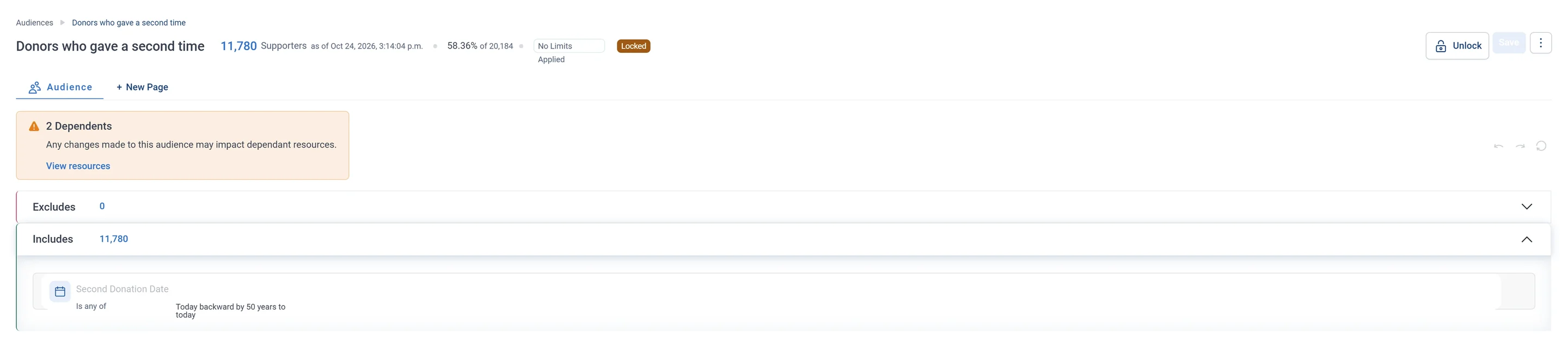
Donors who gave a second time · Audience rules This is the audience of donors who gave a second time. It is built from one simple rule about gifts, so a small team can start with a first gift and see who came back.
The weeks after a first gift decide whether there's a second one. Every charity has first gifts, so every charity can start here.
Day 0: a thank-you that names what brought them in.
Day 2: a thank-you call for the largest first gifts.
Day 14: a story of what their gift made possible.
Day 60: a second ask that names their first gift.
When the second gift comes, the person moves into stewardship. And you can see, person by person, who came back in time.
That's a first step you can measure.
Finding future major donors without a model
Analytics books teach you to build scores in a statistics package. That works if you have an analyst. Most small teams don't, so they go by memory.
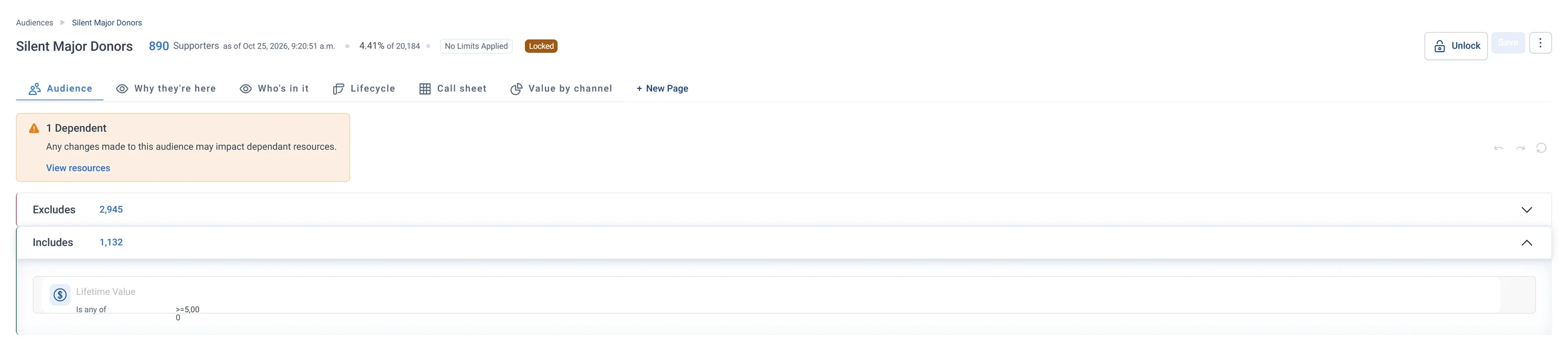
Silent Major Donors · Audience rules, part 1 of 2 This is the Silent Major Donors audience and the plain rules that build it. It finds people who may give more without a statistics package.
But the signals are already in your records. A supporter who gives steadily for years. Who comes to the garden party every summer. Whose family fund gave a grant last year.
Split across three systems, that looks like three small relationships. Read together, it looks like someone ready for a deeper connection.
A ready-made audience can do that reading for you. The supporters who score high go to your major gifts lead. Then comes a personal invitation, an impact story and a cultivation call. The ask comes later.
When the database lives in one person's head
In many teams, one person knows how to pull the call list. When that person is away, the calls wait.
A list that builds itself every Monday changes that. Gifts, events and volunteering are joined into one record per supporter. Each person on the list shows their whole story and the next step. The whole team sees the same list.
One honest limit
This won't make anyone a data analyst, and it doesn't need to. The data still has to come in from each system, and a weekly file export is often enough to start.