Your CRM Doesn't Know Your Donors. It Knows Their Addresses
Article by Kyle Keith, 3 February 2026
A CRM is a filing cabinet: it records gifts well but can't connect giving with events, email and volunteering. Kyle Keith shows what RNLI, VSO and NSPCC gained from an insight layer that sees across systems, and makes the case for the CRM companion model.
First published on LinkedIn on 3 February 2026. Edited for this site on 6 November 2026: every number links its source.
Why Your CRM Was Never Designed to Be Your Brain
Take one example.
The VP of Development stared at two reports sitting side by side on her desk.
The first came from the CRM: 847 donors had given $50,000 or more lifetime. The second came from the annual giving team's spreadsheet synthesis: 923 major donor prospects, including 212 "high potential" names she'd never seen before.
"Where did these 212 come from?" she asked.
"Event attendance data," her associate replied. "Combined with email engagement scores from Mailchimp and volunteer hours from our separate volunteer management system. None of that lives in the CRM."
She pulled up one of the 212 records. Margaret Chen. According to the CRM: a $250 one-time donor from 2019. No recent activity. Flagged as lapsed.
According to the spreadsheet synthesis: Margaret had attended six events in the past two years, volunteered 47 hours at the food bank, opened 94% of emails, and clicked through to read every impact report. Her employer matched gifts at 200%. She'd been a board member at a sister organization before moving to the area.
The CRM showed a lapsed $250 donor. Reality showed a deeply engaged supporter whose lifetime value potential likely exceeded $100,000.
The VP had two questions:
First: How many other Margarets are hiding in plain sight, invisible because the CRM only sees transactions?
Second: Why did she have a $30,000 per year CRM that couldn't tell her this?
The first CRM software, ACT!, was released in 1987 by Pat Sullivan and Mike Muhney's company, as software to manage sales processes and customer engagements. In practice, it was a digital Rolodex. When Tom Siebel founded Siebel Systems in 1993, it was known mainly for "Sales Force Automation." Not "Customer Intelligence." Not "Relationship Insight." Sales Force Automation.
The name reveals the original purpose: automating transactions, not generating insights.
This isn't a criticism. Transaction processing matters. When a donor gives $1,000, you need a system that records the gift accurately, generates the receipt correctly, and updates the record reliably. That's what systems of record do well.
But filing cabinets don't think. They don't connect dots across folders. They don't recognize that the person in the "volunteers" folder and the person in the "event attendees" folder and the person in the "email subscribers" folder are all the same Margaret Chen showing major gift signals.
Klaviyo's blog puts it directly: "Traditional CRMs were never built to address the needs of B2C businesses. CRM features like lead scoring and account management suit the structured sales cycles of B2B. But they're largely irrelevant in the fast-paced, transactional world of B2C."
The same applies to nonprofits. Your CRM was built to track the pipeline stages of an enterprise sales cycle. It wasn't built to understand why Margaret Chen volunteers every Saturday but hasn't given since 2019, and what that pattern means for her cultivation potential.
That last phrase is the key: it doesn't come together anywhere.
Your CRM stores donor records. Your email platform stores engagement data. Your event system stores attendance records. Your volunteer database stores hours and activities. Your peer-to-peer platform stores fundraising campaigns. Your advocacy tool stores petition signatures.
Each is a system of record for its specific domain. None is a system of insight across domains.
For nonprofits, the consequences are measurable. The 2025 CCS Philanthropy Pulse found that 54% of organizations cite inaccurate or incomplete data as a key challenge to using their donor data.
In Harvard Business Review Analytic Services research for Salesforce, only 31% of respondents said they have a single, 360-degree view of customer data, and half of them said they lack the organizational structure to make use of it. That means most organizations still operate with a fragmented picture despite their CRM investments.
Questions Your CRM Can Answer
Who gave last year?
What was our total revenue by fund?
How many donors do we have?
What's the average gift size?
Questions Your CRM Cannot Answer (Without Help)
Which lapsed donors are still deeply engaged through other channels?
What's the correlation between event attendance and major gift upgrades?
Which email subscribers have never been asked to give?
What's the true lifetime engagement value (not just dollars) of each supporter?
Who's showing major gift signals across multiple touchpoints but hasn't been identified for cultivation?
The first set queries a single data source. The second set requires connecting dots across sources.
Your CRM was built for the first set. Nobody mentioned that limitation when you signed the contract.
The 55% Failure Rate: What the Research Actually Shows
For: Anyone who's been burned by an "easy integration" that wasn't
The Statistics Are Worse Than You Think
Johnny Grow's CRM failure research found 55% of the people it surveyed said their CRM project failed to meet its objectives. When objectives weren't met, they missed them by 51% on average.
Only 25% of projects achieved their objectives, timeline, AND budget.
The Johnny Grow research revealed additional patterns: 7 in 10 implementations exceeded planned timelines by 30% or more. The median budget overrun was between 30% and 49%. Users were 4x more likely than managers to have their objectives and benefits discarded.
Root Causes Span Three Domains
In my experience, failures fall into three categories:
Organizational factors drive many failures: a missing business strategy, too little process change, and too little executive support. Good change management makes a real difference.
Technical factors create hidden complexity. Data quality work is frequently overlooked in project budgets, legacy system integration adds cost, and poor integration with other tools holds many CRMs back.
Adoption factors ultimately determine success or failure. If users don't adopt the CRM, it fails, and training that doesn't stick makes that worse.
The Hidden Costs Nobody Budgets For
The visible licensing costs represent only a fraction of CRM total cost of ownership.
Staff turnover dramatically amplifies these costs.
When staff depart, they take institutional knowledge of system configurations, workarounds, and donor relationships. The person who understood "David's formula" in the spreadsheet, the one who knew which fields to check when the sync failed, the one who remembered why that custom field existed: they're gone.
This is why knowledge that lives in documented systems rather than in people's heads matters so much. When architecture is standardized and the data model is pre-built, turnover doesn't reset your data infrastructure to zero.
What RNLI and VSO Discovered When They Added a Brain to Their Filing Cabinet
For: Anyone who wants to see what good looks like
The Royal National Lifeboat Institution had a problem that sounds familiar: teams operated independently, leading to over-marketing of the best supporters, while ring-fencing kept some supporters from ever being offered certain products.
Their research teams understood donor profiles and motivations. Their insight teams understood behavior. But knowledge rarely came together. Pieces of the supporter picture sat with different teams. Each told part of the story. None told the whole story.
Their campaign selection relied mainly on recency and frequency measures. Supporters could quickly lapse out of selection models because the models couldn't see engagement happening in other channels.
For example, a lifelong supporter who visited lifeboat centers twice a year, volunteered on weekends, and bought merchandise regularly could be flagged as "lapsed" simply because they hadn't made a donation in 18 months. The filing cabinet couldn't see what was obvious to anyone who looked at the full picture.
How can we put supporters in control of their own relationship with us?
Are our departments siloed in ways that hurt supporter experience?
Do we understand supporter engagement beyond transactions?
Are we organized around products and departments, or around supporters?
What would it take to see one complete supporter story instead of many partial ones?
These aren't technology questions. They're organizational questions. At RNLI, the technology work came after the organizational review.
The Single Supporter View Solution
RNLI built what it called a single supporter view (SSV): one consolidated profile for each supporter. The solution started with insight drawn from that view using Apteco's FastStats analytics engine.
Data depth (how much information they held on each supporter)
Relationship history (tenure and history)
Using clustering, they grouped supporters into segments and built a progression framework for supporter journeys. Rather than static "major donor" or "lapsed donor" classifications, the framework showed how supporters could move toward higher engagement.
The combination of behavioral data (what supporters actually did) with primary research into what made supporters tick created a 30-segment model that was both sound analysis and humanly meaningful.
The RNLI Results
They first tested the cluster segmentation on the 2012 Christmas Appeal.
VSO (Voluntary Service Overseas) faced a similar challenge: multiple disparate systems with no unified supporter view.
They created a single supporter view across three systems, using match rules to remove duplicates so that every individual was represented only once. This view was integrated into their insight and orchestration platform, using Apteco's PeopleStage for journey automation.
Key elements included:
Lifetime value and ask strategy models
Behavior-driven journeys based on model scores, response windows, and recency
Consent and channel preference logic built into the single supporter view, ready for future use of soft opt-in data, with SMS added as a channel
Multi-team collaboration across fundraising, digital, and data teams
Apteco's FastStats and PeopleStage are crucial for NSPCC's supporter experience communications, enabling tailored, automated journeys for various activities including donation acknowledgements, event stewardship, and fundraising campaigns... supporting millions in fundraising while minimising resource use through sophisticated automation.
The pattern is consistent: organizations keep their CRMs as systems of record while adding a companion layer that provides the insight and orchestration capabilities the CRM was never designed to deliver.
Why These Approaches Worked
None of these stories is about replacing a CRM. Each is about adding something on top.
The insight layer could see what no individual system could see alone: the complete supporter story.
The supporter who "lapsed" from giving but increased volunteer hours wasn't lapsed.
The occasional donor who visited centers twice monthly was showing major gift signals.
The email subscriber who never clicked fundraising appeals but shared every advocacy petition was engaged, just not in the way traditional metrics measured.
The Vendor Paradox: Why Your CRM Provider Can't Solve This Problem
For: Anyone evaluating technology investments
The Salesforce Paradox
Salesforce is the dominant force in nonprofit CRM: more than 56,000 nonprofits and educational institutions have started with its Power of Us program. It excels as a system of record, meticulously tracking donor interactions and gift histories.
But this strength creates a paradox. While it holds the most valuable constituent data, in my view Salesforce was not fundamentally designed to be a system of insight or a dynamic campaign orchestration engine.
In my experience, organizations using Salesforce alone face these challenges:
Cost-prohibitive scaling. Licensing costs for additional user seats can prevent organization-wide access to donor data. Marketing, analytics, and strategy teams are often locked out, creating data silos within the organization that supposedly unified their data.
Storage and performance limitations. Standard Salesforce storage allowances are quickly used up by the transactional, behavioral, and historical data required for deep analytics.
Limited marketing capabilities. Native Salesforce marketing tools fall short on sophisticated multi-channel orchestration, advanced analytics, and predictive modeling.
The Acquisition Problem
In my view, both Salesforce and Blackbaud have grown through acquisition strategies that leave fragmented product portfolios requiring ongoing integration work.
The vendor incentive is to keep you inside their ecosystem. If you use their email tool, their event tool, their analytics tool, you're locked in. Switching costs compound.
But products built separately and acquired later don't magically become one integrated system. They remain separate systems with API connections between them.
The consulting model creates its own incentive problems.
Simple solutions don't require expensive consulting. Complex implementations do. This doesn't make anyone dishonest. It creates structural misalignment between what you need (unified insight) and what vendors provide (additional products to integrate).
The CRM Companion Model: Preserving Your Investment While Adding What's Missing
For: Organizations ready to see their supporters clearly without starting over
The Third Path
The picture is consistent: CRMs were designed as transactional systems of record, not analytical systems of insight. The 55% implementation failure rate and persistent integration challenges across all major platforms reflect this fundamental architectural limitation.
Rather than expecting transactional CRMs to evolve into insight engines, or ripping out systems that work well for their intended purpose, there's a third path: add a companion layer that provides what your CRM was never designed to deliver.
This approach preserves your CRM as the essential system of record while augmenting it with a system of insight and orchestration.
What a CRM Companion Actually Does
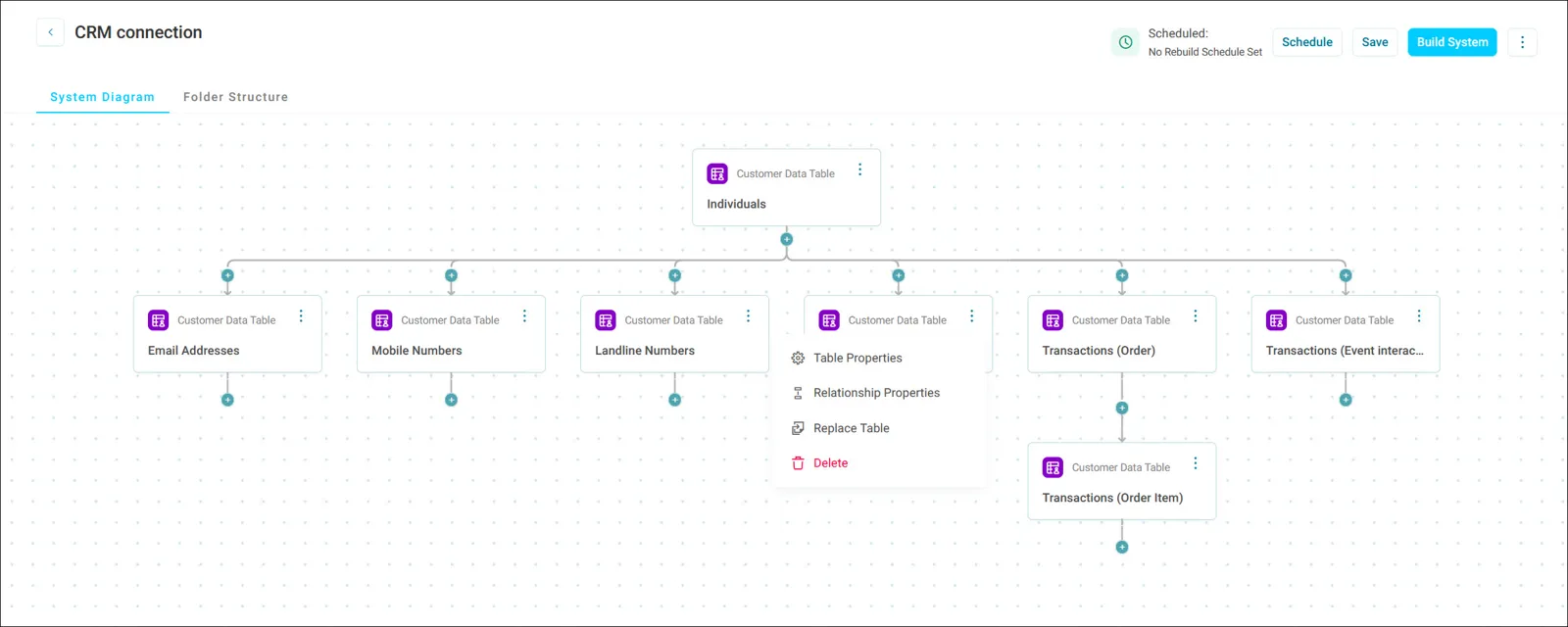
Data fusion from multiple sources. Nonprofits often run several disconnected applications. Rather than building and maintaining custom integrations between each pair of systems, a companion layer pulls data from all sources into one place. When built with push-button, metadata-driven connections, extraction and transformation happen automatically rather than requiring custom development for each source.
System builds This is a system built in Orbit that connects the CRM to other tables, like email addresses, phone numbers and transactions. It shows how a companion joins the sources without replacing the CRM.
Pre-built nonprofit schemas. Enterprise CDPs require months of custom configuration to understand nonprofit data models. Pre-built schemas understand donor relationships, household structures, gift attribution, campaign hierarchies, and engagement tracking from day one. The decisions about how to structure donations, campaigns, events, and communications have already been made correctly based on decades of nonprofit data experience.
Automated identity resolution. The duplicate nightmare from How Duplicate Records Kill Donor Retention and the foreign key challenges from Database Architecture for Humans get handled automatically. When data flows in from your CRM, donation platform, event system, and email tool, matching happens without manual intervention. Your CRM can remain messy. The insight layer organizes the data correctly when it's pulled together for analysis, segmentation, and campaign execution.
Advanced analytics without requiring data scientists. Predictive modeling, lapse prediction, RFM analysis, and lookalike modeling become accessible to fundraisers through visual interfaces, not SOQL queries. The companion layer brings capabilities that basic CRM reporting and dashboards cannot provide.
Multi-channel orchestration from unified data. Visual, drag-and-drop journey builders design and automate complex, multi-step campaigns using CRM data as the foundation. Email, SMS, direct mail, and digital advertising execute from one platform based on the complete supporter picture rather than fragmented channel views.
Knowledge that survives turnover. Because the architecture is standardized and documented, it doesn't depend on any single person's memory. When staff leave, the system remains intelligible. Staff turnover doesn't reset your data infrastructure to zero.
The Implementation Reality
The entire process can be completed in weeks, not months, so organizations quickly start using their system of record and their new system of insight together.
It shouldn't take years, a team of data scientists, and a rip out of existing systems.
As you saw in the case studies, they added a companion layer. They kept what worked. They added what was missing.
What This Means for Your Organization
You probably don't need a new CRM.
You probably don't need a years-long implementation.
You probably don't need a team of consultants building custom integrations.
You probably need a way to see your supporters as whole people, not as fragments scattered across filing cabinets.
The question isn't whether your CRM is good at what it does. It probably is. The question is whether you're asking it to do something it was never designed to do.
Filing cabinets store files. Brains connect dots.
Your CRM is an excellent filing cabinet. It needs a brain.
Self-Assessment: Where Does Your Organization Stand?
Score yourself on each question (1 = Not at all, 5 = Completely):
Can you identify supporters who are highly engaged across multiple channels but haven't made recent donations?
When a major donor prospect is identified, can you see their complete interaction history (events, emails, volunteering, advocacy) in one place?
Do your campaign selection criteria include engagement signals beyond giving history?
Can your development team answer cross-system questions without IT support or manual data exports?
If a board member asks "who are our most engaged supporters," can you produce an answer that accounts for non-financial engagement?
If your most knowledgeable data person left tomorrow, would someone else be able to explain how your systems work and connect?
Scoring:
24-30: Strong insight capability. Focus on fine-tuning and activation.
17-23: Gaps exist. You're likely missing major donor signals and engagement patterns.
10-16: Significant blind spots. High-value supporters are invisible to your current systems.
6-9: System of record only. Your CRM is a filing cabinet without a brain.
The Path Forward
Geoffrey Moore was right: systems of record are necessary conditions of doing business. Your CRM handles that necessity well.
But mission effectiveness comes from insight. From seeing the complete supporter story. From recognizing Margaret Chen's major gift potential despite what the CRM shows.
RNLI didn't achieve a 53.5% increase in responders by replacing their CRM. They achieved it by adding an insight layer that could see what no single system could see alone.
In the next article, we'll explore how to capture the engagement signals happening outside your CRM and connect anonymous visitors to known supporters before they disappear.
Because every website visitor who leaves without identification is a relationship you never got to start. And every known supporter whose digital engagement you can't see is a relationship you're managing blind.
About This Series
This series is part of the Apteco Mission launch: a consolidated insight platform built specifically for small-to-medium nonprofits who've been underserved by enterprise solutions.
If you're tired of being told the only options are costly enterprise implementations or DIY spreadsheet heroics, we built this for you.
This article is part of "The Nonprofit Data Architecture Series": articles exploring how nonprofits can build data infrastructure that enables personalized stewardship, accurate reporting, and mission-focused decision making.