Your Donation Page Knows More About Your Donors Than Your CRM Does
Article by Kyle Keith, 13 February 2026
Your website, email platform, event tool, donation page and CRM each hold part of every donor's story, and none of them holds all of it. This article explains how anonymous visitors become known donors, where that bridge breaks, and what changes when your systems are introduced to each other.
First published on LinkedIn on 13 February 2026. Edited for this site on 6 November 2026: every number links its source.
For example, here's how a development director might spend her Tuesday morning:
She pulled a donation report from her payment processor. She exported an email engagement list from her email platform. She downloaded event attendance from her event tool.
She opened all three spreadsheets side by side and spent 90 minutes manually cross-referencing names to figure out which gala attendees also opened last month's appeal email and gave in Q4.
She found 11 people. It took an hour and a half.
The data to answer that question existed in three systems at 8:00 AM. The systems just didn't know about each other.
This is the most expensive problem most nonprofits don't realize they have. Not because the information is missing. Because the introduction was never made.
One Donor, Five Systems, Zero Visibility
For: Anyone who has ever manually cross-referenced two exports
Let's follow one person through your systems.
A woman named Sarah finds your organization through a Google search. She reads your impact page, clicks to your donation page, looks at the suggested amounts, and closes the tab. Your website analytics tool records an anonymous visitor who spent 4 minutes on two pages. Your donation platform records nothing, because she didn't start the form.
Two days later, Sarah signs up for your email newsletter through a popup on your homepage. She uses her work email: sarah@example.com. Your email platform creates a new contact. It has no idea she visited your donation page 48 hours ago, because your email platform and your analytics tool don't talk to each other.
Over the next month, Sarah opens four of your six emails. She clicks the link about your spring gala. She clicks a program update about clean water. Your email platform tracks all of this. It knows sarah@example.com is highly engaged. Your CRM knows nothing about any of it, because most email platforms don't include engagement data in standard contact exports. That data lives in a separate system, behind a separate API call or a CSV export no one has set up.
Sarah registers for your gala. She uses her personal email: sarah.jones@example.org. Your event registration tool creates a new contact. It sees a first-time registrant. It has no idea this person has opened four emails in a month, because the event tool sees sarah.jones@example.org and the email platform sees sarah@example.com. Different emails. Different systems. To your tech stack, these are two strangers.
At the gala, Sarah is moved by a story from the stage. She writes a $500 check. Your team enters the gift into your CRM under "Sarah Jones" with the Gmail address from the check. The CRM now has a $500 first-time donor. It doesn't know she spent a month engaging with your emails. It doesn't know she visited your donation page before she ever subscribed. It doesn't know she clicked on clean water content twice, which would tell a development officer exactly which program to reference in a stewardship call.
Your analytics tool sees: one anonymous visitor, one donation page view, no conversion. Your email platform sees: sarah@example.com, high engagement, clicked gala link. Your event tool sees: sarah.jones@example.org, attended spring gala. Your CRM sees: Sarah Jones, $500 first-time donor. Your donation page sees: one anonymous abandonment weeks ago. No follow-up triggered.
Five systems. One person. The full picture exists. No single system holds it.
This isn't a technology failure. Every one of these tools did exactly what it was designed to do. The failure is architectural: nobody introduced them to each other, and nobody told them that sarah@example.com and sarah.jones@example.org are the same person.
Plenty of people keep more than one email address, one for work and one for everything else. This means Sarah isn't an edge case. She's your donor base.
The 88% Signal That Disappears Between Systems
For: Development teams making decisions with incomplete data
That means 88% of people who found your donation page, read your ask, and considered giving... left.
Most organizations treat this as a conversion rate problem. Better copy. Simpler forms. Fewer fields. Those matter. But they miss the bigger insight.
Someone who reached your donation page demonstrated more engagement than the website visitors who never got that far. They found you, navigated to the giving page, and considered it. That's not a bounce. That's someone raising their hand and putting it back down.
If someone visits your donation page three times in two weeks without completing a gift, that behavioral pattern tells a development officer something concrete: capacity, interest, and hesitation. Maybe the ask amount was wrong. Maybe they want a conversation first. Maybe they're planning a larger gift and your $50 suggested amount felt insufficient. But you'll never see that pattern if your website analytics, email platform, and CRM exist in separate rooms.
But here's the critical question most articles on this topic skip over: how do you actually identify who that anonymous visitor was? Your donation page doesn't collect an email address from someone who leaves. Your analytics tool shows you an anonymous session. So how does "follow up with the person who abandoned your donation page" actually work in practice?
That's the mechanism most nonprofit technology writing hand-waves. It deserves a real explanation, and I've given one below.
Page load speed tells a parallel story: the slower your donation form loads, the more people give up before they give. In my view, where and how your donation form loads can matter more to conversion than most email copy tweaks. Infrastructure choices wearing design costumes.
How Anonymous Visitors Become Known Donors (And Where the Bridge Breaks)
For: Anyone who's been told to "track your website visitors" without being told how that actually works
This is the most important technical concept in the article. Skip it and everything else is theoretical.
An anonymous website visitor is just a browser session. Your analytics tool sees a device, a location (roughly), pages visited, time on site, and traffic source. It does not see a name or an email address. It cannot, on its own, tell you who that person is.
So how does an anonymous session become a known donor? There are exactly three bridges, and every nonprofit should understand how each one works.
Bridge 1: Email click-through tracking.
This is the most reliable and most common bridge for nonprofits, and it works through your email service provider (ESP).
When you send an email through an ESP with click tracking turned on, the links in that email carry a unique subscriber identifier, embedded in the URL. When Sarah clicks a link in your newsletter, she lands on your website with that identifier attached. If your website has a tracking script installed (most ESPs provide one, and dedicated tracking pixels serve the same function), the script sets a first-party cookie on her browser. That cookie associates her device with her email address.
From that point forward, every page Sarah visits on your website from that browser is no longer anonymous. The tracking script recognizes the cookie and ties the session to sarah@example.com.
Here's the part that matters most: this works retroactively. If Sarah visited your donation page anonymously last Tuesday, and then clicked an email link on Thursday (setting the cookie), a system running batch analysis can go back and connect Tuesday's anonymous donation page visit to the person who identified herself on Thursday. The anonymous session and the identified session came from the same browser. The cookie links them.
That retroactive connection is where the real analytical value lives. You're not just tracking what known visitors do going forward. You're recovering the history of what they did before you knew who they were.
Bridge 2: Form submission.
When Sarah fills out your newsletter signup popup and enters her email address, the same mechanism fires. The form submission triggers a cookie (or updates an existing one) that ties her browser to sarah@example.com. Every previous anonymous visit from that same browser can now be attributed to her, and every future visit is tracked as a known session.
This is why form design matters beyond conversion rates. Every form on your website, whether it's a newsletter signup, donation, event registration, volunteer interest form, or resource download, is a potential identity bridge. Each one is an opportunity to convert an anonymous visitor into a known supporter whose full browsing history becomes visible.
Zeffy's advice on donation forms puts it plainly: "Every extra field is a chance to lose a donor." That's a conversion point. But it's also an identity resolution point: simpler forms mean more completions, which means more cookies set, which means more anonymous visitors become known.
Bridge 3: Login or authentication.
If a supporter logs into an account on your website (a member portal, a volunteer hub, a donor dashboard), the login event identifies them. This is the most definitive bridge but the least common for nonprofits, because most nonprofit websites don't require accounts.
Where the bridge breaks.
This is the part that matters just as much as the mechanism itself, and most technology vendors won't tell you.
The bridge only works when the anonymous visitor eventually takes an identifying action: clicking an email link, filling out a form, or logging in. If someone visits your donation page and never interacts with your organization again, they remain anonymous forever. No platform can identify them individually, without using data-brokers.
This means the realistic goal is not "identify every visitor." It's "maximize the percentage of visitors who eventually self-identify, and then retroactively connect their full history when they do."
That reframe changes the strategy entirely. Instead of chasing tracking pixels and surveillance tools, the priority becomes: make it easy and valuable for visitors to give you their email address early in the relationship. Newsletter signups. Content downloads. Event registrations. Preference surveys. Every touchpoint that captures an email is an identity bridge waiting to activate.
And then: run the analysis that connects the dots. Because the email click happened last Thursday. The anonymous donation page visit happened last Tuesday. The form submission happened three weeks before that. No single system recorded all three events. The connection only becomes visible when you pull the data together and run the match.
That's not a real-time automation problem. It's a batch analysis problem. And it's where the compounding value of connected data becomes concrete.
Where the Wires Actually Cross
For: Anyone who's been told to "integrate our systems" without a budget or a plan
The gap between "we have data" and "our data talks to each other" is a configuration gap. But configuration still requires understanding what each system actually produces and where the disconnections live.
Every nonprofit platform produces data in two ways: through APIs (real-time, two-way, like a phone call) and through exports (batch files, like postal mail). The difference determines how fast you can act on a signal.
Form tools vary wildly. Some fire real-time webhooks the instant a form is submitted, pushing data directly into your CRM. Others require manual exports or middleware. Some have no native webhook capability at all. If your volunteer signup form lives in a tool like that, the data sits there until someone moves it. That's not a criticism of those tools. It's a structural reality that shapes everything downstream. It also means that form submission, despite being an identity bridge, may not trigger any downstream action unless you've built the automation to move the data.
Donation platforms present their own gaps. Some capture UTM parameters (the tracking codes embedded in email links that tell you which campaign drove the gift). Others don't. Some have webhooks for every transaction event. Others lack webhooks for refunds or recurring gift failures. If your processor doesn't notify your CRM when a recurring gift fails, that lapsed supporter sits in your database looking "current" until someone manually runs a reconciliation report.
Email platforms have a gap most nonprofits don't know about: many popular platforms don't include engagement data (opens, clicks, link-level behavior) in standard contact exports. That data requires a separate API call or export. Syncing email engagement to your CRM often cannot be done through a simple contact list download. This is why Sarah's email behavior was invisible to her CRM. The data existed. The export path didn't. And remember: email click-through tracking is the primary bridge between anonymous web visitors and known identities. If that click data doesn't flow to a central system, the bridge exists but nobody walks across it.
CRM access isn't equal either. Some platforms gate API access behind specific subscription tiers. Others offer open access with strong documentation. The practical difference: one organization can programmatically reach its own data. Another literally cannot access its own records without paying for an upgrade.
The universal matching key across all of these systems is email address. Which brings us back to the core problem. Email-based matching connects records cleanly when both systems hold the same address. The rest requires secondary matching: name plus address plus postal/zip code, phone number matching, or manual review.
This is identity resolution. And it determines whether the bridges described above produce insight or just produce more disconnected data.
A single donor appearing as three records doesn't just waste postage. It means three separate communications, three different engagement histories, and zero ability to see the full picture. It compounds through every analysis, every report, and every automated decision built on top of that fragmented foundation.
For nonprofits, false positives (incorrectly merging two different people) are more dangerous than false negatives (failing to connect records that belong to the same person). Merging the wrong records can cause data loss and damage donor relationships. Think about attributing the wrong gift amount because two records were incorrectly combined. That's why identity resolution needs to be systematic and rules-based, not manual and improvised.
The Structural Decisions That Compound for Years
For: Leaders making infrastructure decisions (or inheriting someone else's)
The decisions your predecessor made in the first two weeks of platform setup are still shaping your reporting accuracy today.
The "system of record" decision. You need one authoritative source for each type of data: the CRM for donor records, the email platform for engagement metrics, the donation processor for transactions. When two systems contain conflicting information about the same supporter (and they will), which one wins? Without this decision made explicitly, staff create workarounds. Workarounds become habits. Habits become data chaos that survives multiple staff turnovers.
Field naming. "Street" entered as "St.," "St," or "Str." makes geographic reporting unreliable. "CA" versus "California" breaks segmentation. Phone numbers stored as 415-555-2671, +14155552671, and 4155552671 create three records for the same person. These aren't theoretical problems. They're Tuesday morning.
The principle from practitioners: every form field should use dropdown menus and picklists over free text wherever possible. Predefined values prevent the data entry inconsistencies that create duplicates and break segmentation. Donation forms, volunteer signups, event registrations, communication preferences: all of them.
The junior administrator trap. A pattern that's endemic in the sector: budget-constrained organizations hire junior administrators who prove value by overbuilding. More fields, more automations, more friction. Each administrator creates tactical fixes instead of designing with a roadmap. When that person leaves, the next admin rebuilds the system in their own image. Technical debt multiplies with every handoff.
Data decay. Your address, email, and phone data degrades every quarter. Without automated maintenance, your database isn't aging. It's actively becoming less true.
Incomplete or inaccurate data is the accumulated weight of many small structural decisions made without a framework, compounding over years, through multiple staff turnovers, without documentation.
What Changes When the Introduction Gets Made
For: Leaders who need to see what "the other side" looks like
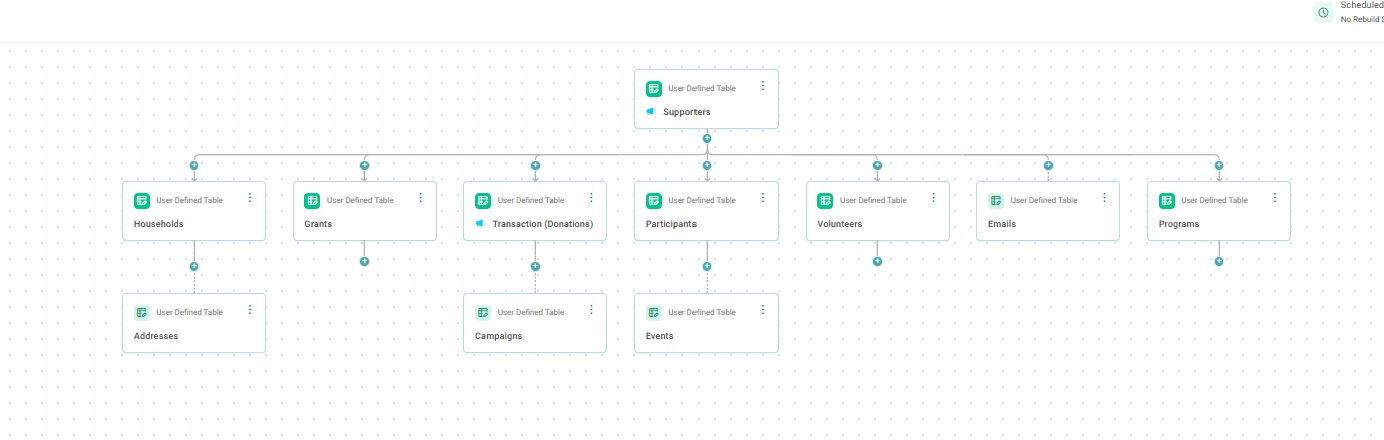
This is how Orbit joins the tables about each supporter. Households, events, gifts and volunteering all hang from one supporter record.
Go back to Sarah. Same person, same five systems. But this time, the systems have been introduced to each other, and the bridges are working.
Sarah visits your donation page. Your website has a tracking script installed, so the visit is recorded with a browser cookie. She doesn't give. She's anonymous.
Two days later, she signs up for your newsletter with her work email. The form submission sets a cookie that ties her browser to sarah@example.com. Now something important happens: a batch analysis run connects her newsletter signup to her anonymous donation page visit two days earlier. Same browser. Same cookie. The system now knows that the person who abandoned your donation page on Tuesday is the same person who subscribed on Thursday.
Your development team doesn't need to be watching a real-time dashboard for this to happen. The analysis runs on a schedule, pulls data from your website tracking, your ESP, and your CRM, matches records by email and cookie identifiers, and produces a unified view. Sarah's record now shows: donation page visit (abandoned), newsletter subscription, and the time gap between them.
An automated follow-up triggers. Not a hard sell. A message acknowledging her interest and offering a way to learn more about the programs she was exploring.
Over the next month, Sarah clicks on clean water content twice and the gala invitation once. Those clicks are tracked by the ESP with unique identifiers. Each click reinforces her profile: content interest, engagement frequency, behavioral trajectory.
She registers for the gala with her personal email: sarah.jones@example.org. The batch analysis matches "Sarah" at sarah.jones@example.org to "Sarah" at sarah@example.com using name plus secondary identifiers. One profile. Two emails. The system doesn't panic about the mismatch. It resolves it.
She gives $500 at the gala. Her CRM record now shows a month of engagement history: the initial donation page visit, the newsletter signup, four email opens, two clean water content clicks, gala registration, and the gift. Your development officer doesn't see a $500 first-time donor. She sees a highly engaged supporter whose behavior pattern suggests significantly more capacity. The stewardship call references clean water, because the system knows that's what Sarah clicked on. The follow-up ask is calibrated to her demonstrated interest, not to a generic first-time donor template.
None of this required real-time artificial intelligence. It required structured data from five sources, connected by email address and browser cookie, analyzed in batch runs that retroactively stitch anonymous behavior to known identities.
That's the mechanism. And it's what separates organizations that react to donations from organizations that see them coming.
This is what organizations with connected infrastructure are already doing.
In an Amazon Ads case study, UNICEF USA and its ad agency matched donations, including gifts made by phone or check, to ad engagement, and measured a 366% direct return on ad spend for the campaign.
They added a consolidated insight layer, starting from insight driven from Apteco FastStats and the new single supporter view, and produced a unified view no single system could produce alone.
Sarah is one of those donors. The data to recognize her exists today, scattered across your systems. The question is whether anything is connecting it.
Self-Assessment: Where Does Your Organization Stand?
Score yourself on each question (1 = Not at all, 5 = Completely):
Can you produce a list of everyone who filled a form AND gave a donation in the last 3 months in under 15 minutes?
If the same person uses two different email addresses across your systems, would you know they're the same person?
If a donor abandons your donation page, does anyone or anything follow up within 24 hours?
Can your development officer see a donor's email engagement history on their CRM record?
Do you have a tracking script on your website that connects to your email platform, so that email clicks and web visits are linked to the same person?
When two systems contain conflicting information about the same donor, does your team know which system is the authority?
24-30: Strong infrastructure. Focus on fine-tuning, predictive modeling, and campaign automation.
16-23: Gaps exist. You're likely missing intent signals and leaving retention revenue on the table.
10-15: Significant blind spots. Supporters like Sarah are invisible to your current infrastructure.
6-9: Your systems are filing cabinets without a brain. The good news: closing the gap is a configuration project, not a technology overhaul.
The Path Forward
The core finding from the research behind this article: the gap between nonprofit data collection and data connection is primarily a configuration gap, not a technology or budget gap. Organizations already have systems that produce rich engagement data. They're suffering from lack of connection between the data they already have.
Three immediate actions, in order of impact:
First: ensure every digital touchpoint captures email address as the primary identifier. Newsletter signups, event registrations, resource downloads, volunteer forms. Each email captured is an identity bridge that can retroactively illuminate anonymous web behavior.
Second: confirm your email platform's tracking script is installed on your website. This is the mechanism that connects email clicks to web sessions. Without it, the most reliable bridge between anonymous and known behavior doesn't exist. Most ESPs provide this. Many nonprofits never install it.
Third: use that email to match records across your two or three core systems. That single infrastructure decision gives you the ability to see that the person who abandoned your donation page last Tuesday is the same person who opened three fundraising emails this month and attended your gala last year.
The organizations seeing the largest returns made deliberate structural choices. They standardized field names. They established a system of record. They connected platforms. Then they ran the analysis that stitched the history together.
Some organizations build this infrastructure themselves over months. The manual path is slow to reach measurable impact, and it competes with operational fundraising for every hour of staff time.
Others start with architecture like Apteco Mission that's already been built: prebuilt nonprofit data schemas, automated identity resolution, and batch analysis designed to bring in any structured data source (most of them as a weekly file export), whether that's your CRM, donation platform, ESP, event tool, or website tracking data. Configuration instead of design. Weeks instead of months.
Either path leads somewhere. One arrives significantly faster.