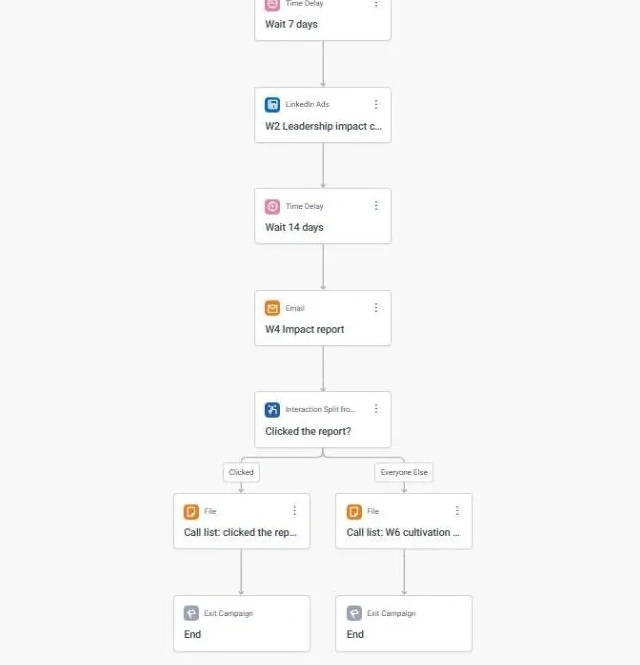
Apteco Mission carries the first moves of the plan for you. Its Sleeping Giants to Major Gifts pathway finds supporters already acting like major donors, passes the top scorers to your major gifts lead, then runs a slow, personal path: a briefing invitation by mail, an impact report by email, and a cultivation call before any ask. Anyone who clicks is flagged for a call. Think of the plan as a journey for each person: one plan per person at the top, one per group below. Each major donor has one owner, a goal, and a next move with a date.
The stages. Moves management moves donors through the donor lifecycle in five stages: identification, qualification, cultivation, solicitation and stewardship. Every donor at every level sits in one of these stages. Treat stewardship as the start of the next cycle, not the end of this one.
Major donors: one plan each. Every prospective donor should have a single assigned owner, and a clear next move for the relationship. Keep each plan to one page: what they care about, their stage, the goal (a purpose, a range and a time), the next few moves with dates and owners, and notes from the last contact. Review the list every week or two. A move should take the relationship forward, not just fill the calendar.
Mid-level donors: a shared sequence. A mid-level sequence for supporters who show the potential to step up can be a check-in with no ask, an exclusive invitation, a one-on-one conversation, then an upgrade proposal. Mission's Upgrade Ask pathway finds donors whose largest gift is more than double their latest, and builds the ask around that peak. Write one plan for the group, with a named person who watches it.
Everyone else: a planned series. First-time, monthly and annual donors each need their own plan of action. For them, the plan is a calendar: a quick thank-you, an update on what their gift did, an invitation, then the next ask. Set it up once, so it runs without a gift officer.
Write down what moves someone up. Agree the signals that move a donor to the next level: a larger gift, several years of giving in a row, a first event, a volunteer shift, a reply to a personal note. Check for them every month. Write down what moves someone down, too, like a year with no contact, so each owner's list stays real.
Keep it in one place. Tailor moves to each prospect, and save every interaction and move. If your plans sit in documents or a spreadsheet today, that is a fine start. You have already thought through the steps. The risk is human error, so move each step into your CRM as a call or a task when you can. The signals that someone is ready often sit elsewhere, though: event visits in ticketing, shifts in a volunteer app. Apteco Mission joins those places into one record per person, beside your CRM.