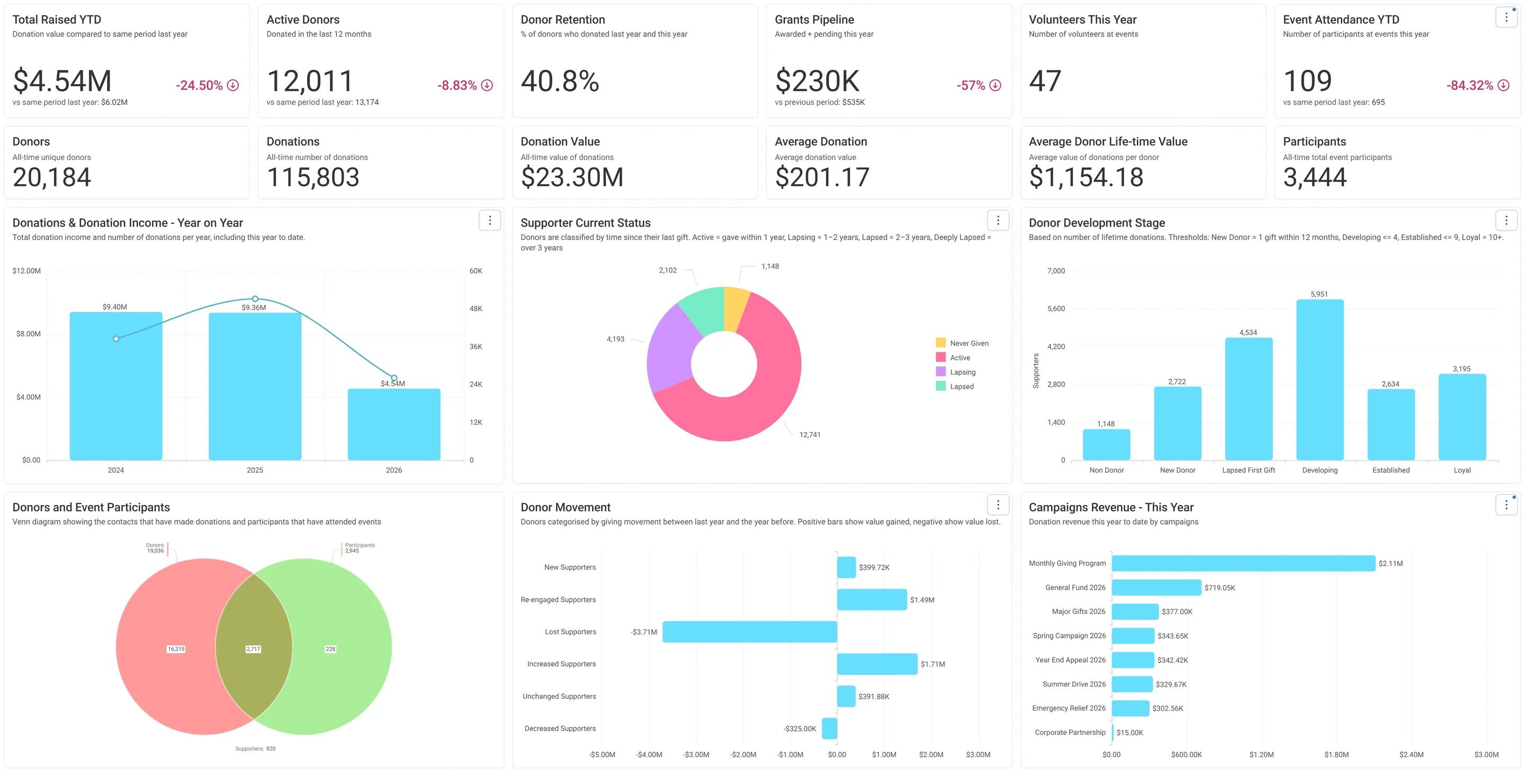
Apteco Mission shows where each supporter sits before you draw tiers. Its Donor Development Stage places each person as Non Donor, New Donor, Lapsed First Gift, Developing, Established or Loyal, as the Charity Overview page explains. The Monthly Giving Conversion pathway finds supporters who give most months, and Donor Median Interval Band groups donors by monthly, quarterly, twice a year or once a year.
Split donors by what they gave in total over the past year, not by their biggest single gift. Set the bands from your own file. Count monthly donors by their yearly total too, so they land in the right band, and give them their own track inside it. Then keep only a few tiers, each with its own care: what they hear, who calls them, and what they are asked for next.
There is no standard mid-level band. TrueSense Marketing defines mid-level donors as people active in the last 24 months who give $1,000 to $9,999 a year in total, with major gifts from $10,000. Another guide says the band is typically $500 to $5,000 a year, and that there is no dictionary definition. Your file decides. Set the top just below where your major gifts staff take over.
Mid-level donors are worth the effort. The Fundraising Effectiveness Project's 2025 report says people who give at mid-levels tend to stay involved more consistently than those giving at lower levels. It calls them one of the best growth opportunities.
How to set your tiers. First, add up each person's gifts over the past year, from every place gifts arrive. Second, sort the list from largest to smallest and look for natural breaks. Third, draw the bands. Fourth, check that each tier has a different plan. If two tiers get the same letter and the same calls, they are one tier. Last, look again each year, as people move up and down. Keep the tiers simple. Every charity draws its major gift line in a different place, and a small team does better with three or four bands it can use than with a dozen it can't keep up.
Monthly donors. One data set shows recurring donors retained at 78% to 80% a year, compared with 32.41% for one-time donors. Group them by monthly amount and by how long they have given. A new monthly donor needs a welcome. A long-time one may be ready to raise the amount. A missed payment needs a quick, kind check.
What each tier gets. Mid-level donors don't need board seats. that guide suggests access instead: impact briefings, invite-only Q&As with program staff, project tours, and a personal call after a significant gift. For the step up, Mission's The Upgrade Ask pathway sends a personal ask anchored to each supporter's peak gift, with the amount filled in automatically. It says that when history is split between an old CRM, the finance system and today's CRM, the peak can sit in a system nobody checks anymore.