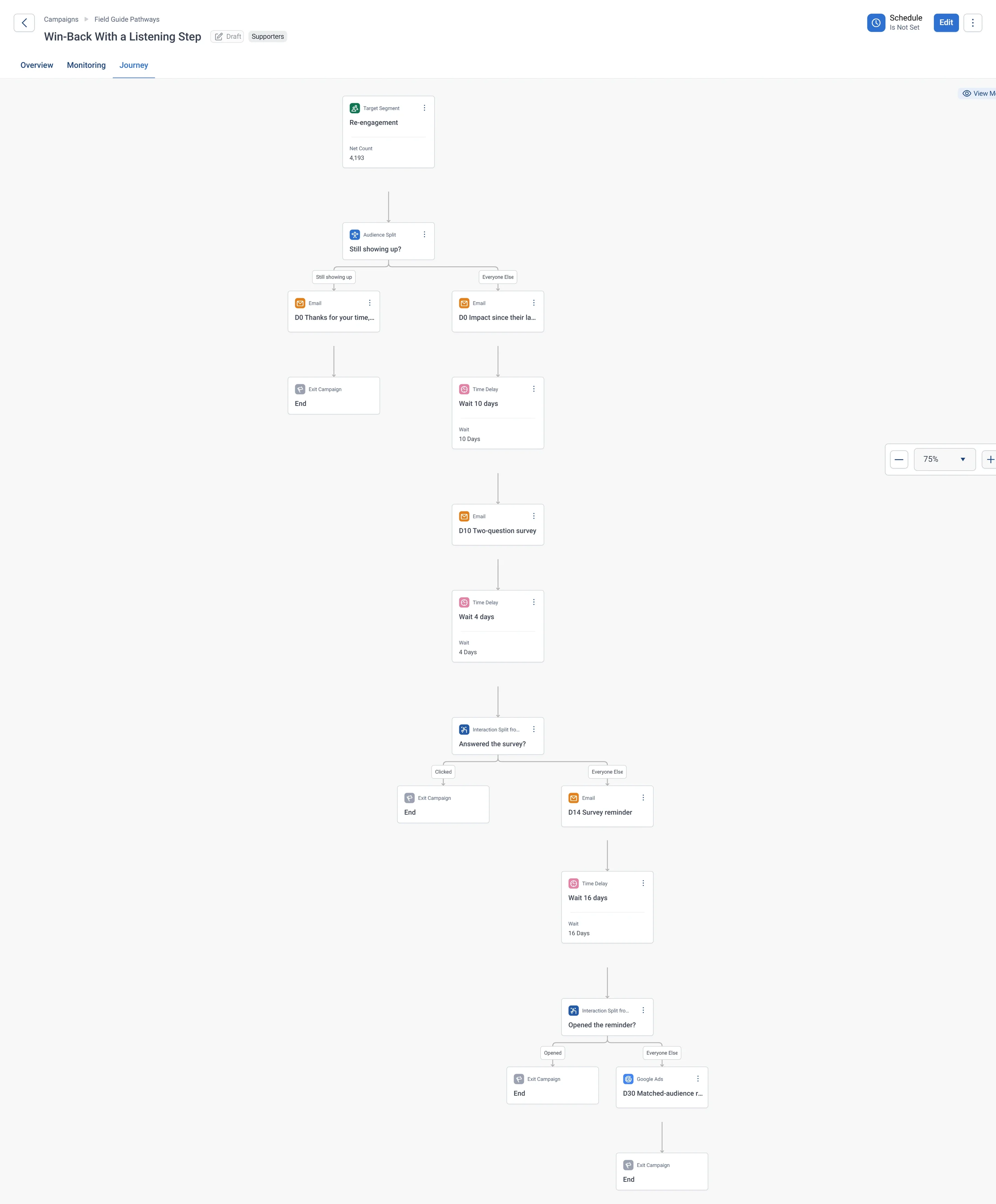
Apteco Mission helps you find who truly lapsed before you write a single note. It does this in its Win-Back With a Listening Step pathway: lapsed givers who still volunteer or come to events get a thank-you, and everyone else gets an update and a short survey on what changed. A handwritten note can help a newsletter get noticed, but the proof it brings donors back is weak. So treat it as a test, and spend the pen on people who once gave a lot first. Add it for half of your lapsed group, leave it off for the other half, and compare who gives again.
Where the idea comes from. A psychology study in 2005 put a handwritten sticky note on a survey. The Behavioural Insights Team reports that 76% of people sent the survey back with the note, and 36% without it. A later trial by Ireland's tax office got 36% back with a note and 19.2% without. Both asked people to fill in a form. Neither asked them for money.
What a fundraising test found. Three economists tested handwritten notes with an opera house in Germany. Past donors got an appeal letter with a thank-you postcard. For about half, the card was written by hand. For the rest, it was printed. In their study, 19.3% of the handwritten group gave, and 18.7% of the printed group. The authors say the gap was not significant. Gifts were not bigger either.
Lapsed donors are hard to win back. The Fundraising Effectiveness Project reports that only 3.0% of donors who had stopped giving gave again in 2025. A note on a newsletter is a small nudge against those odds. So find out what moves your own lapsed donors, rather than guess.
How to run the test. Take the lapsed group you are about to mail. Split it at random into two halves. Send both halves the same newsletter on the same day. Add the note for one half only. Write it by hand, use their first name, and sign it with a name they know. Thank them for what they did before. Then count the gifts from each half over the next few months. If the note half gives more, by enough to pay for the time it took, keep it. If not, try something else.
Check they really left first. The Mission page says a giver the CRM calls lapsed may still be volunteering or coming to events, logged somewhere else. A note that says "we miss you" reads oddly to someone who was at your event last month. Apteco Mission joins donations, events, volunteer timesheets and emails into one record per person, so you can see that before you write. Its survey asks what changed and how they would like to hear from you.