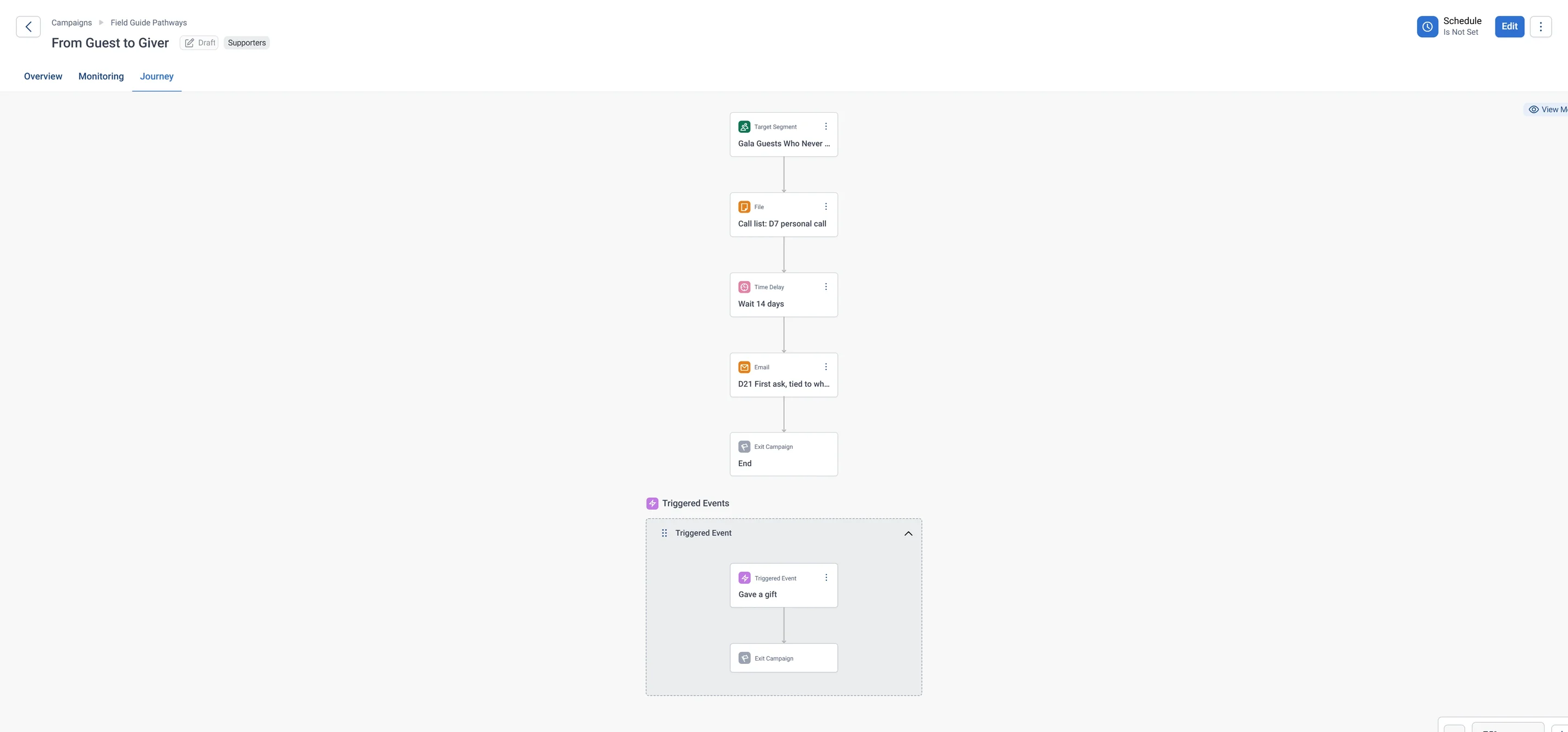
Apteco Mission can show you what guests do after the night. Its From Guest to Giver pathway reads event, attendance status, role and ticket type from your ticketing tool, joins them to each person's gifts, and thanks guests the day after. Your ticketing tool and CRM are where you write things down. Mission is where you ask the question afterwards: who came, and what did they do next? That is the data you need to test a perk on your own guests. See how Mission sits beside your CRM.
The straight answer. There is little proof that event perks keep donors or move them up. The studies of thank-you gifts and recognition mostly measure the gift made at the time, not what a donor does next year. They point both ways. A thank-you gift offered in return for a donation has lowered giving in tests. Public recognition has raised it. So do not assume a perk keeps anyone. Test it, and put more effort into the second gift.
A gift in return can backfire. In six experiments, two researchers found that offering a thank-you gift for a donation lowered what people gave. People expected the gift to help. The drop held across many charities and kinds of gifts, and whatever the gift was worth.
Surprise and recognition can help on the day. In a field test with about 10,000 appeal letters, a small gift sent with the letter, with nothing asked in return, raised the share of people who gave by 17%. A larger gift raised it by 75%. A field test with donors to a university service club found that a promise of public recognition raised gifts. Both studies looked at the gift that followed. That is not the same as keeping a donor.
Even thank-you calls fell short. A study with public TV stations and a national charity assigned 500,000 new donors at random to get a call or not. Fundraisers predicted the calls would raise retention by 80%. The study found no effect on retention. If a call needs proof, so does a perk on the night.
Where retention is won. The Fundraising Effectiveness Project reports that in 2025, 18.9% of new donors gave again, against 59.3% of repeat donors. So plan the steps toward that second gift. Mission's From Guest to Giver pathway follows the night with a thank-you the day after, a call from the host at day 7 to guests who have never given, and a first ask at day 21 tied to what they saw. For upgrades, The Upgrade Ask pathway anchors each ask to the donor's previous peak gift, not a perk level.
Test your perks. Pick one perk, like a VIP reception or a gift bag. Give it to some guests and not others, chosen at random if you can. Or compare guests at the same gift level who did and did not get it. Then follow each group for a year: who gave again, and who gave more. Keep the perks that pay for themselves. Drop the rest, and spend that money on follow-up.