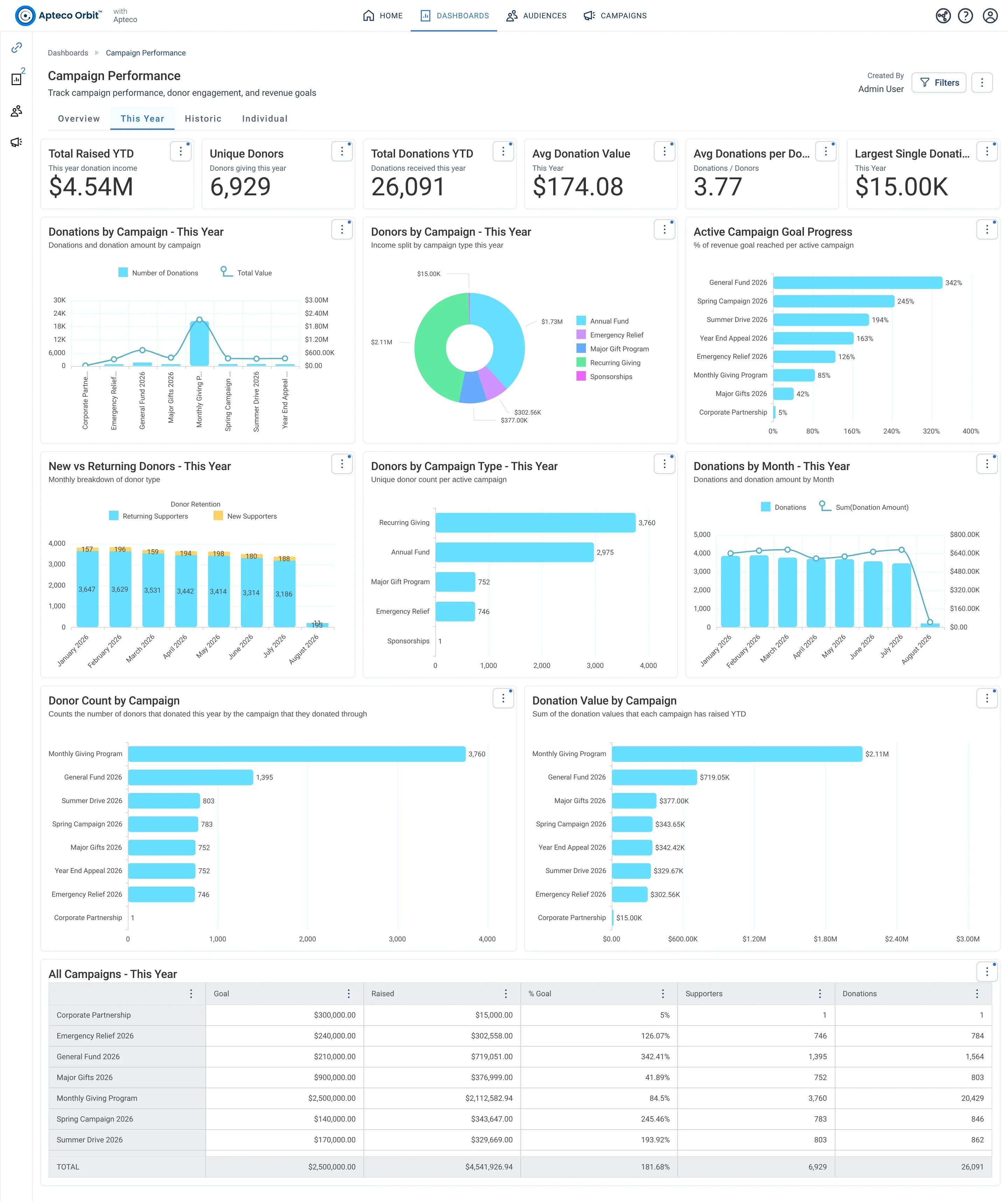
Apteco Mission's Campaign Performance dashboard links each gift to its campaign, so each campaign has a result. It has four tabs: Overview, This Year, Historic and Individual. A fundraiser or board can see which campaigns are ahead of or behind their goals, so the appeal that is falling behind shows up in June, not in December. Working out which email or appeal produced a gift is something fundraisers everywhere struggle with, and the tree you build decides how clean that answer is.
The straight answer: build one tree and code every gift to its lowest branch. The campaign is the big goal, such as this year's annual fund. Each appeal is one effort under it, such as the spring letter. A sub-appeal is one version or stream inside the appeal, such as the email or the event tickets. When each gift carries the most specific code, totals add up the tree on their own, and nothing is counted twice.
Systems name the levels differently, but the tree is the same idea. Some call the top level a campaign, the next one an appeal or solicitation, and the lowest one a sub-appeal. A sub-appeal is a separate source of income inside one appeal, like ticket sales, sponsorships or raffles. Where the money goes sits in its own code, the fund.
Link gifts to the most specific level. Every gift should point to the lowest branch it belongs to. A gift on a child branch then shows on that branch and in the campaign above it. Keep the tree shallow. Too many levels make codes hard to pick and easy to get wrong.
Keep the purpose apart from the effort. Where the money goes (the fund) and how you asked for it (the campaign and appeal) answer different questions. Keep them in different fields. Then one report can show what the spring letter raised, and another can show everything raised for one program, from the same gifts.
Rules that keep reports clean. First, put the year in every appeal name, so this spring's letter never mixes with last spring's. Next, create the codes before the appeal goes out, so gift entry and online forms can use them. Give every online form, event and email its own code. Check each month for gifts with no code. Last, close old codes at year end, so nobody picks them by mistake.
Where it breaks. The tree in the CRM is often fine. The trouble is gifts that arrive somewhere else: a giving platform, a peer-to-peer page, an event ticketing tool. If those carry different names, or no code at all, they never reach the right branch, and the appeal looks weaker than it was.
That is the gap Mission is built for. The Campaign Performance page says email results often stay in the email tool and gifts stay in the CRM, so no one can say which appeal worked. It reads two tables, Donations and Supporters. If you also want a CRM, Apteco hosts CiviCRM, a CRM made for nonprofits.