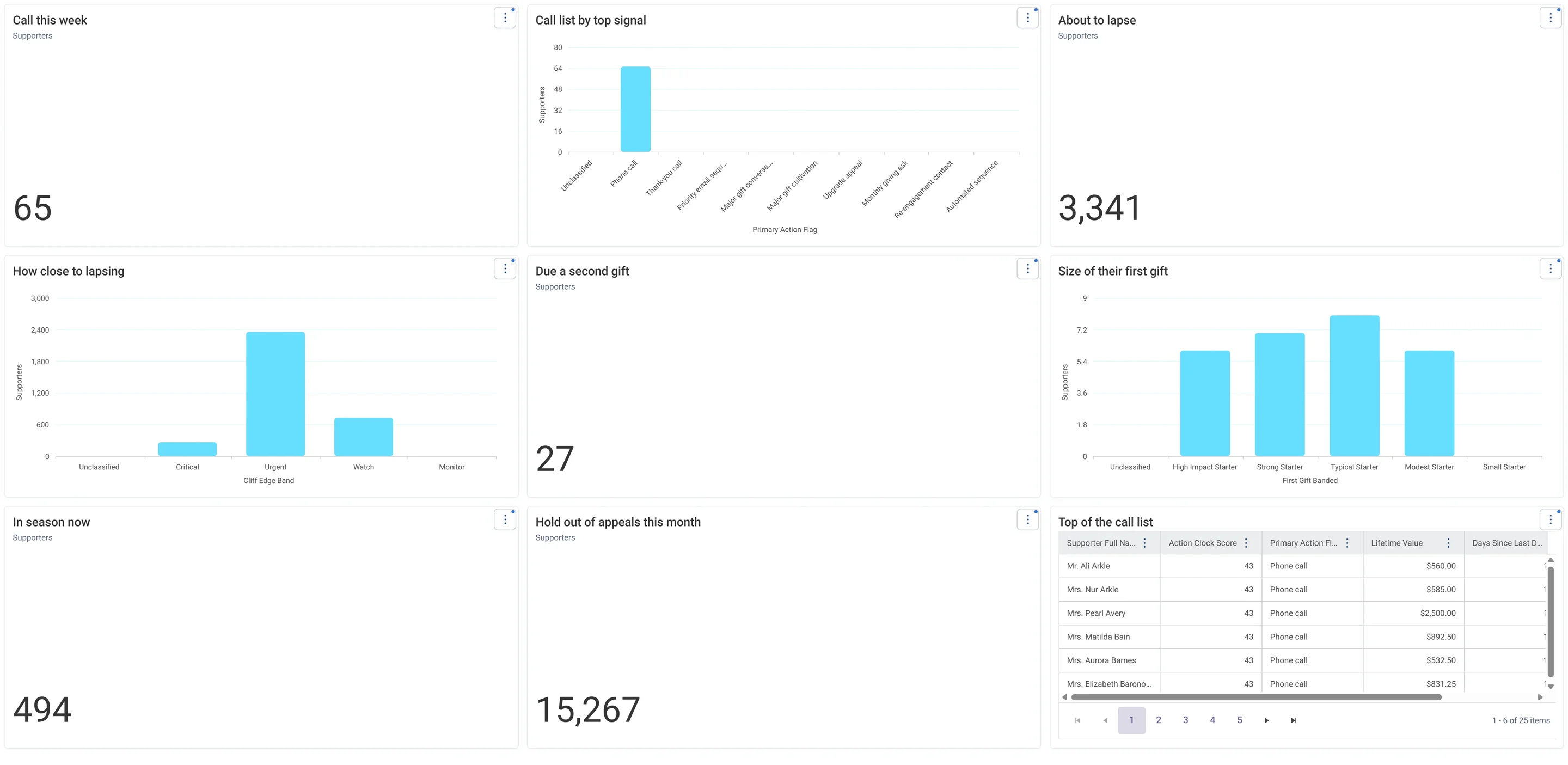
Apteco Mission is for when licences get too expensive, or your CRM only keeps part of the story. It sits underneath your CRM and the other places your supporter data lives, and joins them into one record per person. Your CRM can stay, per the replace-my-CRM answer. The Catch Them Before They Lapse pathway shows what it adds. Some CRMs only report one month at a time, so a supporter's rhythm over the years never shows. The pathway uses each supporter's own giving rhythm to say when they are slipping.
"But our CRM can do almost anything." It probably can, with enough effort. So ask who does that work, and how often. If every new question means a custom report, an export or a spreadsheet, the effort is the real cost. You have outgrown the reporting when the questions you ask can't be answered by the CRM as it is. The usual signs are three. Licences cost more each year as more people need to log in. Reports and scores only use part of your history. And the data you need, like events, online giving and email, lives somewhere else.
First sign: Licences. Many CRMs charge per user. That is fine for three people. It hurts when board members, program staff and volunteers all want to look at a number. If the people who only need to view results are driving the bill, you do not need a bigger CRM. You need a cheaper place to view. Apteco Mission has no seat fees, and your whole team can see it.
Second sign: Limits on history. Some systems keep or analyse only a window of past activity, especially for email and other messages. A score that needs several years of behaviour, like how recently and how often a donor gave, is weaker when it sees only a slice. Check what your system uses when it builds a score.
Third sign: Data outside the CRM. If gifts are in one system, events in another and email in a third, no report sees the whole supporter. The fix is one record per person that all three feed. The Board Pack That Builds Itself pathway says board numbers are often rebuilt by hand before each meeting from the CRM, the finance system, a grants spreadsheet and a coordinator's own counts.
Someone still has to own it. A ready-made layer is not a button that runs itself. Give it an owner: a data person, or anyone on your team who will work inside it and keep the data flowing. That is what turns it from a nice picture into numbers your team uses.
Who this is not for yet. A charity in its first years usually does not need this. A clean CRM and a simple yearly report are enough. Revisit it after two or three years, when the limits start to show.