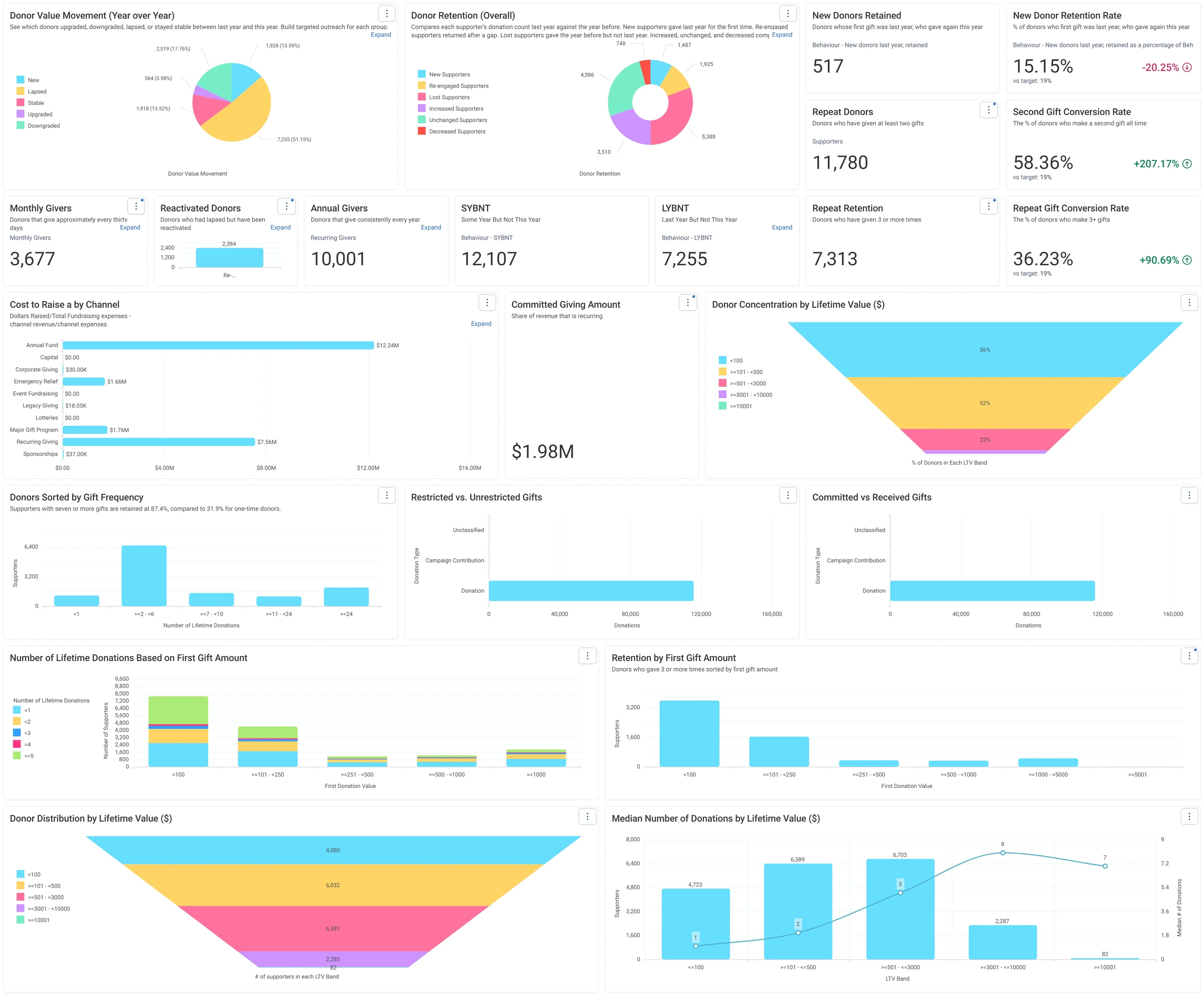
Apteco Mission works out the ratios in this answer for you. Its Board Pack That Builds Itself shows Donor Movement (who came, stayed or left), Retained donors, and each supporter's giving by this same date last year. No benchmark tells you how many donors or events a charity should have. Size, cause and region vary too much. Ratios do compare.
Donor count and retention. Compare your number of donors with the same period last year, then with the sector. The Fundraising Effectiveness Project found the number of donors fell an estimated 3.6% in 2025, while overall retention edged up to 43.3%. If your count falls faster than that, or your retention sits well below it, you need more donors, or to keep more of yours. Count the way the FEP defines retention, so your numbers compare fairly.
Second gifts from new donors. The same report calls new donor retention the sector's most consequential unsolved challenge: turning a first gift into a second. Count how many of last year's first-time donors gave again this year. If few did, more acquisition alone won't fix it.
How much rests on a few. Work out what share of your giving came from your ten largest donors and funders, and watch it each year. There is no sector line for this, but the trend matters. The FEP found growth in 2025 was driven almost entirely by Major and Supersize donors. If your largest donors give a growing share while your donor count falls, losing one gift hurts more each year.
Events: cost, not count. Judge each event by what it costs to raise a dollar, and count staff time if you can. In Canada, the CRA fundraising guidance says that fundraising costs for the year under 35% of fundraising revenue are unlikely to raise questions, and above 70% will raise concerns. In the US, Schedule G of Form 990 asks charities with more than $15,000 from fundraising events to report the gross receipts, direct costs and net income of their larger events.
Do events bring donors who stay? An event can raise little and still be worth it, if guests become donors. Count how many guests were new to you, how many gave outside the event within a year, and how many came back. Apteco Mission's From Guest to Giver pathway looks at event guests who have never given, and its Event Insights dashboard shows which events turn guests into donors.
Where the numbers come from. A board does not need a page of numbers. It needs to decide something, so write down what you will do if each ratio moves. Tickets often sit in a ticketing tool, and online gifts on another platform. Mission joins your CRM and those other places into one record per person, so a guest who later gives is counted once (see the pathway).